

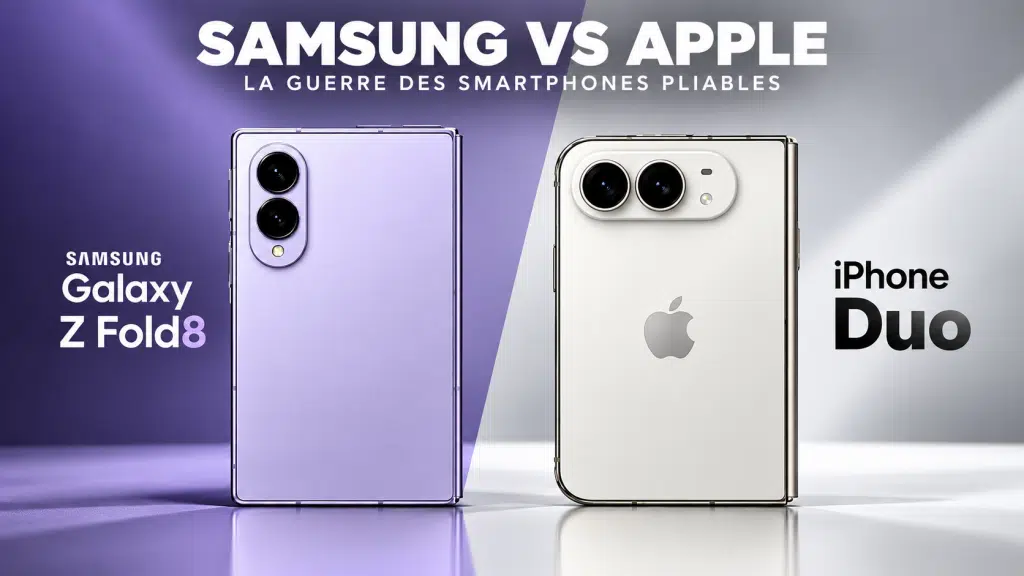
Samsung vs Apple: the foldable smartphone war
Listen to this article
Read aloud by your browser. No audio file is downloaded.
Spoken by your browser. This is not a recorded audio file. The time shown is an estimate.
If you are deciding now, keep Samsung vs Apple in view before the price or the spec sheet.
Samsung could very well have ignored the arrival of Apple on the foldable smartphone market.
The brand chose to do exactly the opposite.
With « Welcome to Foldables », then « It’s Time to Switch », Samsung quickly turned the arrival of the iPhone Duo into a public confrontation. The posts are multiplying, and so are the jabs, with a fairly clear aim: to remind people that Samsung is not a newcomer in the world of foldable smartphones.
But behind the mockery and the advertising campaigns, something more interesting is going on.
Who will manage to impose their vision of the foldable smartphone?
Samsung has several years of experience. Apple arrives with the power of the iPhone and its ecosystem.
And this time, the battle will probably not be won on a spec sheet alone.
Samsung has the experience of the foldable. Apple has the power of its ecosystem and a considerable ability to draw attention to its new products.

Samsung wants to remind people of one thing: the foldable is its home ground
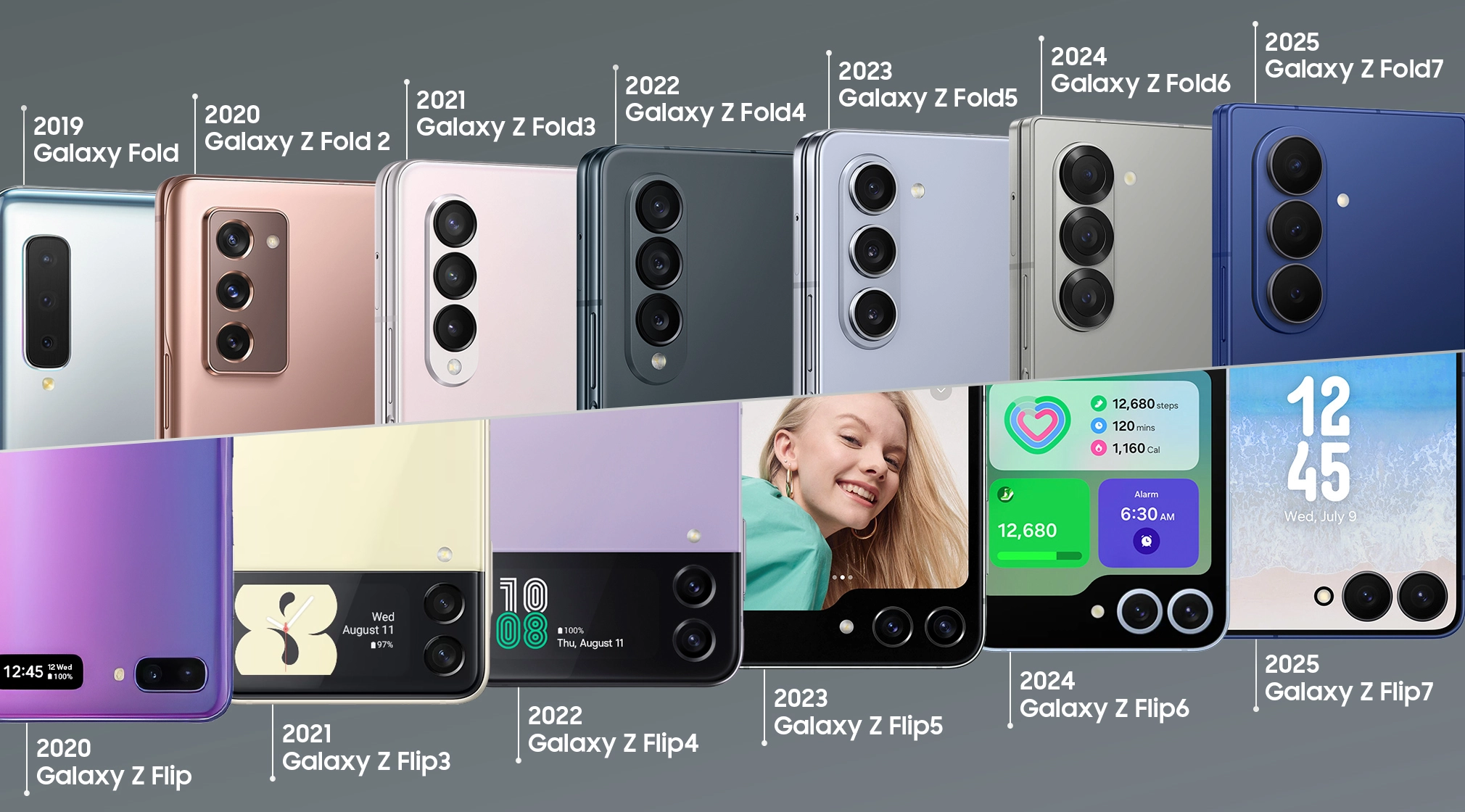
Samsung has been working on foldable smartphones for several years. The brand started building this category long before Apple decided to take an interest in it.
The arrival of the iPhone Duo therefore changes the situation completely.
Until now, Samsung could largely tie its name to the idea of the foldable smartphone. With Apple, the category suddenly becomes much more visible to the general public.
That is exactly why the message « Welcome to Foldables » is interesting.
At first glance, it is only a small provocation.
But the message is much more calculated than it looks:
In other words, Samsung is not only trying to compare two phones. It is trying to influence how consumers will tell the story of this new battle.
Apple would naturally want to present its foldable as a new step in the evolution of the iPhone.
Samsung prefers to tell another story: Apple is entering a category that Samsung has already helped to build.
And this difference in storytelling matters enormously.
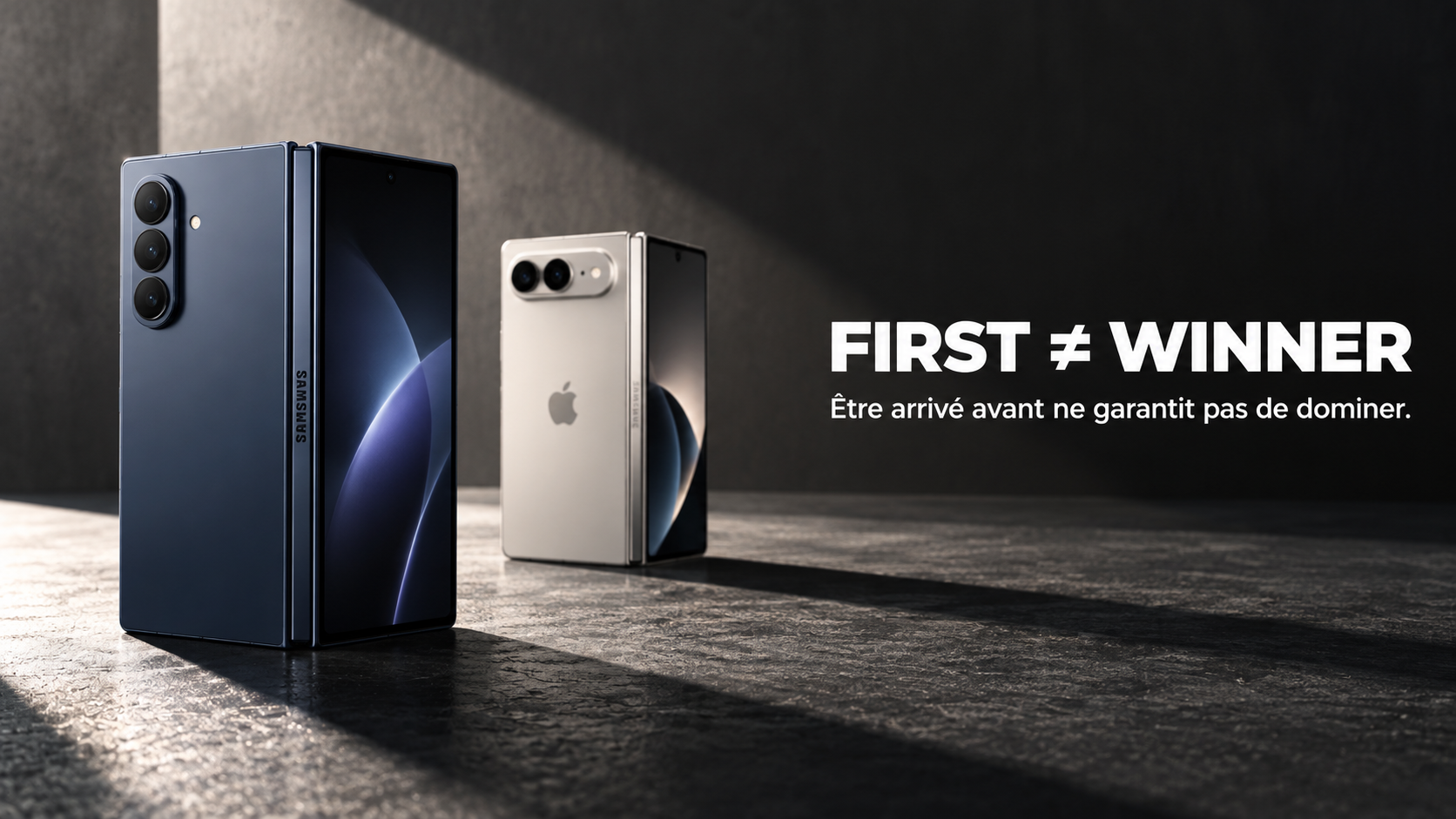
Being first still does not guarantee a win
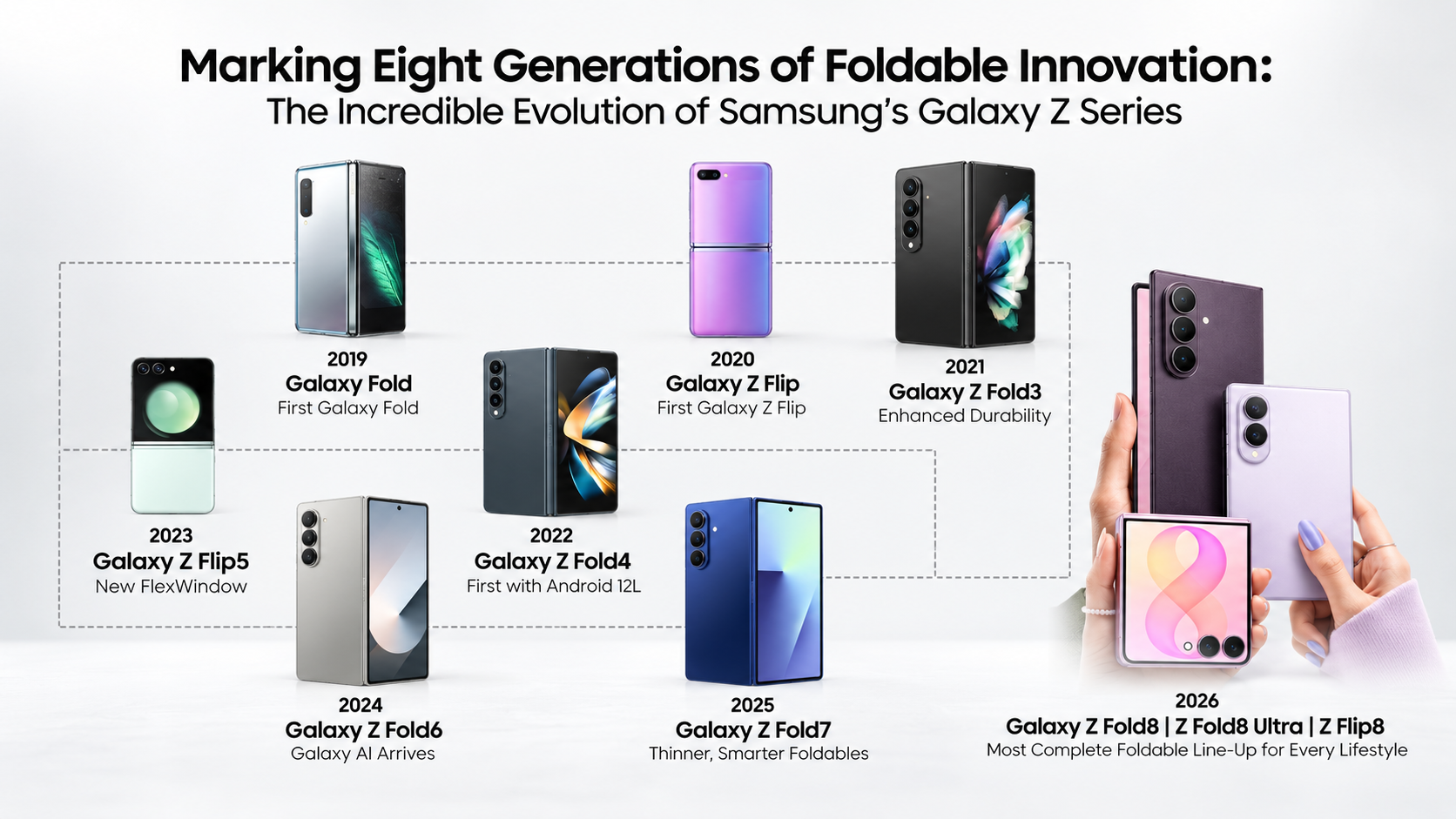
In technology, the first to enter a market is not always the one that ends up dominating.
Apple therefore does not need to convince consumers that foldable smartphones exist.
Samsung has already taken care of that.
Apple simply has to convince part of the public that its interpretation of the foldable is interesting enough to change their habits.
And that is where the situation becomes much more delicate for Samsung.
From mockery to “Switch”
At the start, Samsung plays mostly the provocation card.
But the strategy changes quickly.
With « It’s Time to Switch », the message becomes much more interesting: Samsung is no longer only trying to get a laugh at the expense of Apple. It is starting to speak directly to iPhone users who might consider moving to Galaxy.
Why does this matter?
Because a smartphone is not changed like a pair of earphones.
When a user leaves an iPhone, they are not only changing phones. They sometimes have to rethink part of their digital environment: iMessage, AirDrop, iCloud, Apple Watch, accessories, habits and services.
Samsung is therefore attacking an obstacle that appears on no spec sheet:
the fear of change.
A user can recognise that a Galaxy has an excellent screen or a very good camera and still stay with Apple.
They already know their system.
Their photos are there.
Their devices work together.
Their habits are in place.
The problem for Samsung is therefore not only to convince the user that the Galaxy is better.
It also has to make them think:
“Switching to Samsung will not be that complicated after all.”
Samsung is no longer selling only a phone
This is what makes the current campaigns interesting.
A classic comparative advert could simply say:
Our phone is thinner.
Our screen is better.
Our camera is better.
Samsung goes further.
The brand is trying to tell a story about changing.
Even the campaign featuring an estate agent named Tim Cook, in New Zealand, plays on the same idea. The nod to the chief executive of Apple is deliberately absurd, but anyone who follows the technology world understands it immediately.
And that is precisely the point.
A good campaign does not always need to explain very much.
Sometimes it only has to provoke a reaction.
Make people smile.
Make them talk.
Make them share.
Samsung has understood that well.
But there is a problem: Samsung talks a lot about the iPhone Duo

This is probably the most interesting paradox in the whole story.
Samsung wants to weaken the arrival of Apple.
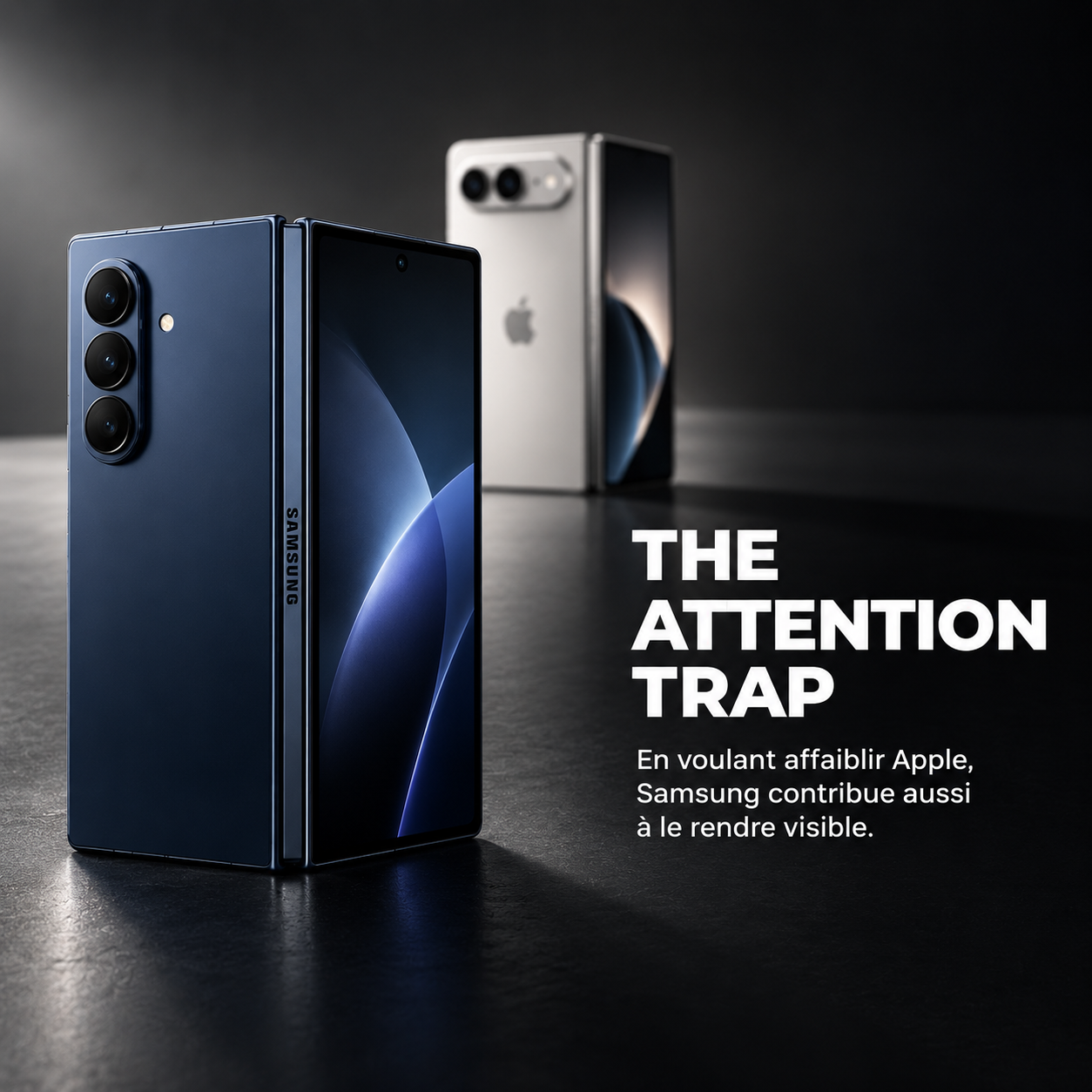
But every time Samsung publishes a new attack, the name iPhone Duo spreads even further.
The media talk about it.
Social networks pick up the posts.
Users comment.
In the end, Samsung itself helps make known the product it is trying to fight.
That is the risk of comparative campaigns.
In trying to say:
“Apple is late.”
Samsung also reminds people:
“ Apple now has a foldable smartphone.”
For a category that is still relatively small beside the smartphone market as a whole, this visibility can be particularly useful for Apple.
Samsung therefore has to find the right balance.
Attack enough to defend its territory, but not so much that the iPhone Duo becomes the new reference in the market.
The real advantage of Apple is not the foldable
Apple is arriving late.
But Apple is not arriving from nothing.
That is the whole difference.
Millions of users already know the iPhone. They may already use iCloud, AirPods, Apple Watch, Mac or other services from the brand.
Apple therefore does not need to explain its whole universe to the public.
It can simply present the foldable as a new step in the evolution of the iPhone.
And that simplicity can become a formidable weapon.
Samsung has to explain why its foldable experience deserves to be chosen.
Apple can potentially say something much simpler:
“It is an iPhone. It opens.”
The sentence is almost too simple.
And yet that is exactly what makes it powerful.
Samsung has the experience. Apple has the attention.

That is probably the best way to understand the current situation.
Samsung has several generations of foldable smartphones.
Apple has a brand capable of turning every new product category into a global event.
Samsung knows the problems of the foldable.
Apple knows how to create desire around a product.
Samsung can talk about its lead.
Apple can talk about the iPhone experience.
Both arguments are solid.
And neither guarantees victory.
The first estimates mentioned after the launch also show that the market does not treat Apple as a mere new entrant. Counterpoint estimated that Apple could reach about 25% of the global foldable-smartphone market, against 38% for Samsung. These figures should of course be taken for what they are: projections, not a final result.
And there is another irony: they can be rivals and partners
The marketing war sometimes gives the impression that Samsung and Apple move in two completely separate worlds.
In industrial reality, it is much more complicated.
Apple can call on suppliers linked to Samsung, notably for displays.
In other words, two companies can fight fiercely in front of consumers while keeping commercial relationships behind the scenes.
This is not really a contradiction.
It is simply how the technology industry works.
Being a competitor does not necessarily mean being entirely independent of that competitor.
The real test will not take place on social networks

For the moment, Samsung has won something precious:
attention.
Its campaigns get people talking.
But attention does not automatically mean sales.
The real battle will start when consumers have both devices in their hands.
Will an iPhone user really be ready to leave their ecosystem for a foldable smartphone?
Will a Galaxy user consider that the Fold8 is still more interesting?
Does the foldable format bring enough value to justify a price that can approach 2,000 dollars?
And above all:
will foldable smartphones become genuine mass-market products, or stay a premium category reserved for some users?
These questions will count for much more than posts on X, Instagram or TikTok.
A new battle is beginning
For a long time, Samsung could present itself as the specialist in the foldable smartphone.
That position is now much harder to defend.
Apple has just entered the category.
And with Apple, what arrives is not only new components or a new spec sheet. It is an ecosystem, a brand image and a global community.
Samsung does, however, possess something Apple cannot pick up in a few months: years of experience with foldables.
The battle is therefore far from decided.
Samsung wants to say:
“Apple has only just arrived.”
Apple can say:
“The foldable is finally coming to the iPhone.”
Both stories can work.
But a third person has the last word:
the user.
Because a campaign can earn a click.
An advert can earn a laugh.
A brand can create anticipation.
But in the end, it is everyday experience that makes someone change phones.
And that is probably where the real war between Samsung and Apple begins.
❓ FAQ — Samsung vs Apple and foldable smartphones
Why is Samsung attacking the iPhone Duo?
Samsung wants, in particular, to remind people that it has several years of experience with foldable smartphones and that it is not a newcomer in this category.
What does “Welcome to Foldables” mean?
The message presents Apple’s arrival as that of a new entrant in a category Samsung says it has already helped to build.
Is Samsung necessarily advantaged because it was there before Apple?
Not necessarily. Experience is an advantage, but being first in a market does not automatically make you the leader.
Why does “It’s Time to Switch” matter?
This campaign is no longer limited to mocking Apple. It speaks directly to iPhone users and tries to reduce, in the mind, the fear of changing ecosystem.
What is Apple’s main advantage in this battle?
Apple arrives with a large base of iPhone users and an ecosystem already in place. The foldable can thus be presented as a new step in the iPhone experience.
Does Samsung risk giving the iPhone Duo too much publicity?
Yes. That is one of the paradoxes of comparative campaigns. By attacking the iPhone Duo regularly, Samsung also increases the product’s visibility with the public.
Who has the advantage today: Samsung or Apple?
The answer remains open. Samsung has the experience in foldable smartphones, while Apple has a brand, an ecosystem and a considerable ability to command attention.
Will advertising decide the winner?
No. Campaigns can generate attention and shape perception, but the real experience of users and the value the devices deliver will be decisive.
A careful look at Samsung vs Apple avoids paying for a feature you will not use.
Global Zone customers usually ask about Samsung vs Apple when they compare two close options.
Treat Samsung vs Apple as one criterion next to battery life, noise, weight and updates.
Nothing in Samsung vs Apple replaces checking the exact model number on the box.
For a shop in Morocco, Samsung vs Apple should be read together with local availability.
If you are deciding now, keep Samsung vs Apple in view before the price or the spec sheet.
The useful reading of Samsung vs Apple is what changes for a buyer in Morocco, not the slogan.
Warranty, stock and after-sales support matter as much as Samsung vs Apple itself.
A careful look at Samsung vs Apple avoids paying for a feature you will not use.
Global Zone customers usually ask about Samsung vs Apple when they compare two close options.
Treat Samsung vs Apple as one criterion next to battery life, noise, weight and updates.
Nothing in Samsung vs Apple replaces checking the exact model number on the box.
For a shop in Morocco, Samsung vs Apple should be read together with local availability.
Avis des lecteurs
Votre avis compte
Partagez votre expérience et aidez d’autres lecteurs à mieux comprendre ce sujet.
Soyez le premier à donner votre avis.

