

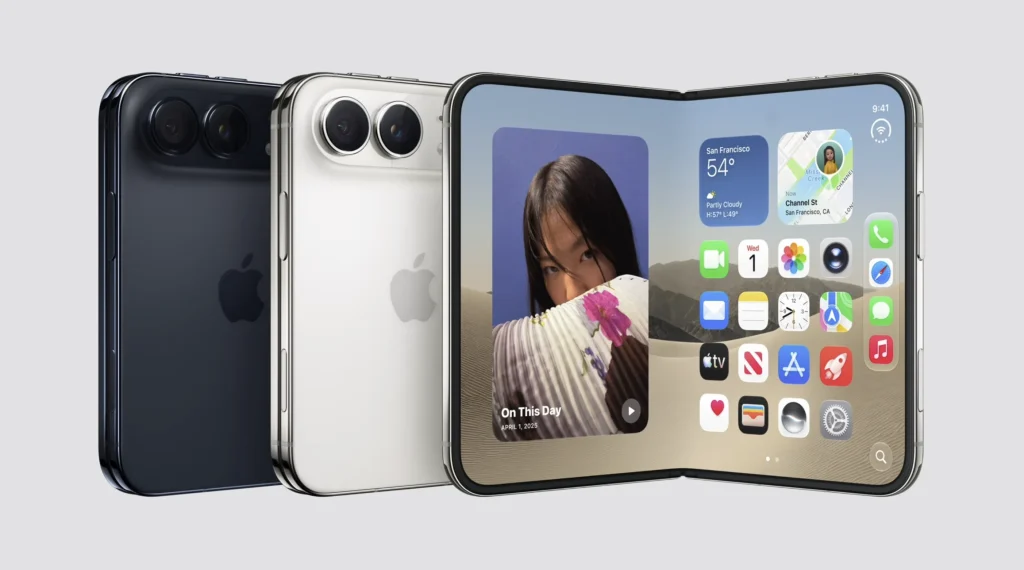
First impressions of the foldable iPhone Duo: Apple’s best foldable, or an iPhone you do not need?
Listen to this article
Read aloud by your browser. No audio file is downloaded.
Spoken by your browser. This is not a recorded audio file. The time shown is an estimate.
If you are deciding now, keep iPhone Duo in view before the price or the spec sheet.
Apple has finally built a foldable iPhone.
But after the 9 September announcement, the most interesting question is no longer whether Apple will release a foldable iPhone.
The answer is already known.
The real question is much harder:
does a foldable iPhone actually change how you use your phone every day?
Because on paper the iPhone Duo is impressive. A 7.6-inch inner display, a 5.4-inch outer display, A20 Pro, two batteries, IP68, Grade 5 titanium, a 48 MP camera, iOS 27 fully adapted to the foldable shape, and up to 2 TB of storage.
But it also starts at 1 999 $ in the United States.
At that price, the iPhone Duo cannot merely be impressive.
It has to be better.
So we looked at the iPhone Duo from two angles: what the new shape actually adds, and the problems foldable phones still have not fully solved.
📱
A surface close to a small tablet when it is open.
⚡
A chip designed to hold high performance.
🛡️
Serious resistance for a foldable phone.
💾
Several storage options, up to 2 TB.
Our answer, before the details
The iPhone Duo is probably the most convincing foldable Apple has ever offered, but that does not mean it will be the best phone for everyone.
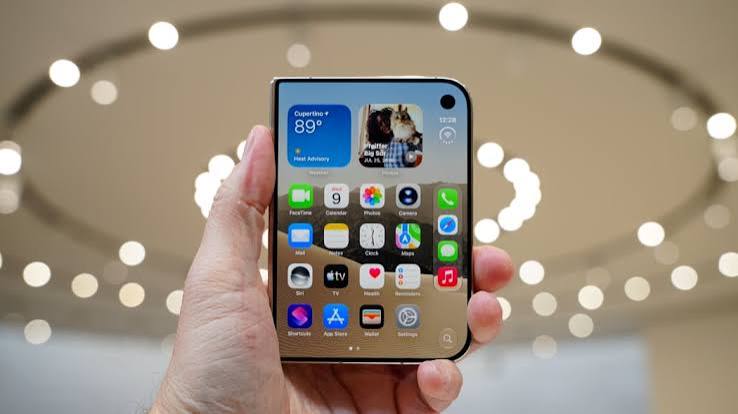
The first hands-on sessions are especially positive about the opening experience, the move between the two displays and the iOS 27 integration. The crease is visible, but it would be very hard to feel with a finger, while the software adapts the interface to how the phone is held.
The basic problem with foldables is still there, though: you buy a lot more technology for an experience you will not necessarily use every day.
And that is where the iPhone Duo gets interesting.
Not because it is perfect.
But because Apple may just have made the foldable shape pleasant enough that more people will actually want to use it.
The iPhone Duo is not simply an iPhone that folds
That is probably the first thing to understand.
Apple did not take a regular iPhone, add a hinge and put a larger display inside.
The Duo was designed around the idea phone plus large display.
Closed, you get a 5.4-inch Super Retina XDR outer display.
Open, the phone reveals a 7.6-inch display.
Apple says the two displays use the same ratio so content can move from one to the other coherently.
The inner display also has a nano-texture finish meant to cut reflections.
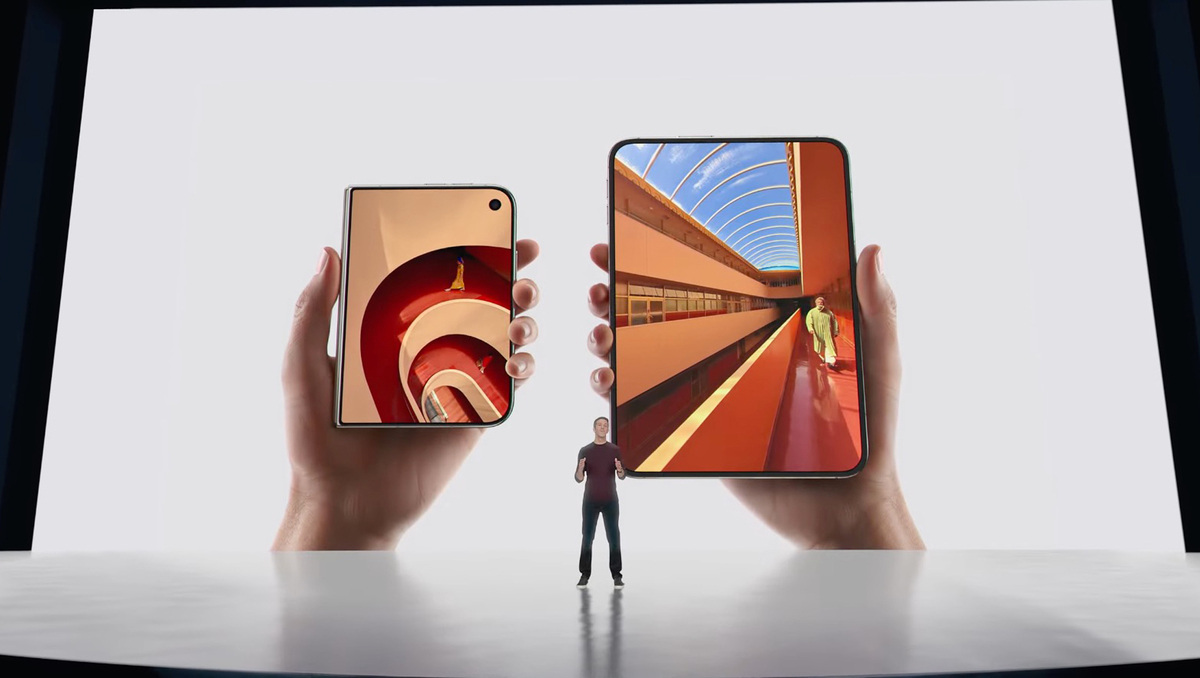
That continuity could be what makes the difference.
In use, the inner display is the real star
Writing 7.6 inches on a spec sheet is one thing.
Actually moving from a phone display to a surface close to a small tablet is another.
The first hands-on notes from Tom’s Guide are especially enthusiastic: the inner display is described as impressive, with a crease that is barely noticeable to the touch. The tester also says the shift from phone to tablet shape feels particularly smooth.
And that is exactly where the Duo starts to make sense.
📖
A more comfortable surface for long reads.
🖥️
A more natural way to multitask.
📄
More room to work on professional content.
🎬
An experience closer to a tablet.
Edit a photo. Take notes. Browse a complex web page.
All of these tasks naturally benefit from a larger surface.
But there is a problem.
You first have to want to open the phone.
And this is where the foldable experience becomes much less glamorous
This is one of the most interesting points raised by PCMag.
After more than a year with a Galaxy Z Fold, the journalist says he sometimes went several days without using the inner display. His experience raises a simple question: if you mostly use your phone closed, why pay for and carry a foldable?
That criticism matters more than it looks.
Because a foldable imposes certain compromises.
- It is more complex.
- It has a hinge.
- It has to protect a flexible display.
- It is generally thicker when closed.
- It costs much more.
The iPhone Duo does not fully escape that logic.
The Duo paradox: it is better open, but you will not always want to open it
This is probably the most important point in our review.
Picture a normal day.
You get a message.
You glance at a notification.
You check your GPS.
You reply quickly on WhatsApp.
You take a photo.
You check an email.
For all of those tasks, a traditional iPhone is more than enough.
You do not necessarily gain anything by opening the Duo.
The large display becomes useful when what you are doing actually needs space.
And that creates two kinds of users.
People who will love the Duo
Professionals, students, creators, people who work a lot from their phone, people who consume a huge amount of content, or who like turning their phone into a mini tablet.
People who may regret the purchase
People who mainly use their phone for messages, social networks, calls, quick photos and navigation.
For them, a regular iPhone could be simpler, cheaper and more practical.
Multitasking: a revolution, or a marketing line?
This is probably the second big debate around foldable phones.
On paper, two apps side by side look extraordinary.
In practice, it is not always that simple.
PCMag rightly notes that multitasking on a phone can sometimes be less useful than you imagine. To watch a video while doing something else, Picture-in-Picture may already be enough. And switching apps is sometimes faster than building a multi-window layout.
Apple is still trying to change that equation with iOS 27.
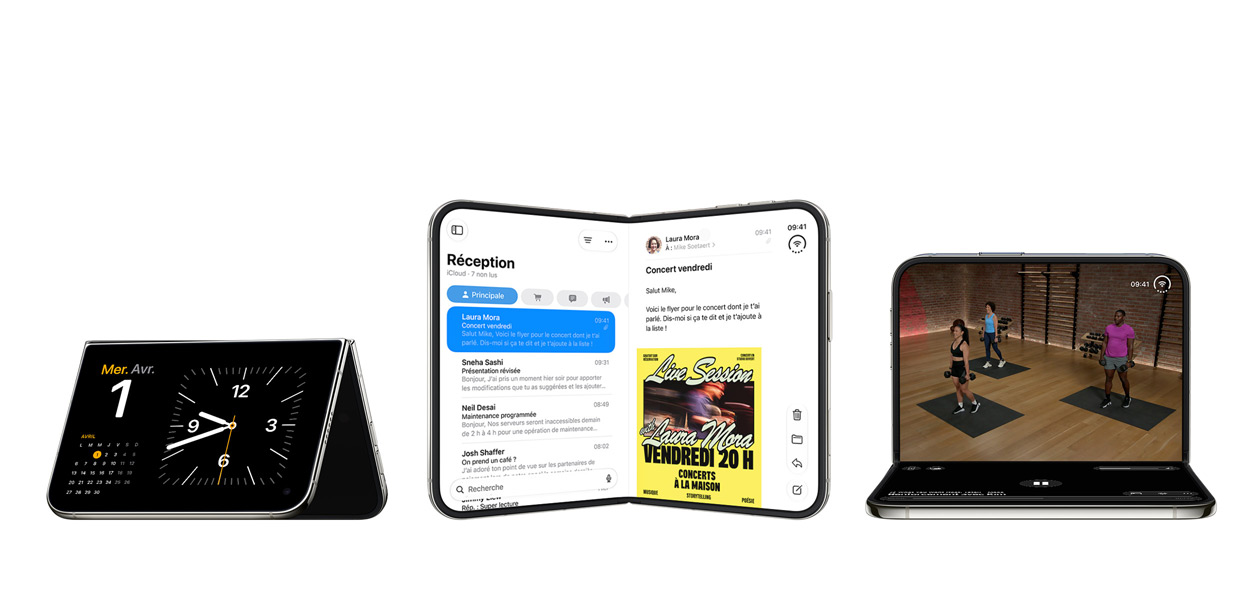
The system has been reworked to use the Duo’s extra surface: the interface adapts to how the device is held, controls are repositioned, and developers get new ways to adapt their apps to the foldable shape.
The difference may therefore come less from the hardware than from the software.
And that is probably where Apple has its best advantage.
The crease: Apple does not make it disappear, it makes it matter less
No, the crease has not magically vanished.
It is still visible.
But the first hands-on notes are interesting: Tom’s Guide says the crease is hard to feel with a finger, even if it stays visible depending on the angle.
Apple also uses a nano-texture layer and a specific protective architecture for its inner display.
The company says in particular that the polymer layer it uses has up to 40% more stiffness than some competing materials.
⚠️
A claim about resistance is not yet proof of durability over three or four years.
And that distinction is essential in a review.
We know the design today.
We do not yet know the real behaviour after thousands of open-and-close cycles, drops, dust, extreme temperatures and several years of use.
Apple does have one important card, though: IP68
This is probably one of the features that will reassure buyers the most.
The iPhone Duo has an IP68 rating.
Apple also says it uses Grade 5 titanium, Ceramic Shield on the outside and Ceramic Shield 2 protection on the outer display.
Tom’s Guide also highlights this advantage against the Galaxy Z Fold 8 and Fold 8 Ultra, which its article presents as less well protected on this point.
For a foldable phone, that resistance matters.
Because the question is not only:
“Does the phone look good?”
But:
“Can I actually live with it every day?”
254 grams: the detail you will probably notice
There is another compromise the official images do not always show very well.
The weight.
Tom’s Guide puts the iPhone Duo at about 254 grams and a thickness of 5.2 mm open against about 11.3 mm closed.
So this is not a light phone.
And when it is closed, it is inevitably much thicker than a regular iPhone.
That is the physical price of the mechanism.
You gain a large display in your pocket.
But you also carry all the architecture required to make it fold.
A20 Pro: Apple has not sacrificed performance
This is one of the points where the Duo becomes particularly interesting.
Apple gives it the same A20 Pro as its iPhone 18 Pro models.
But the challenge is not only to run a powerful processor.
It also has to stop that processor from losing performance too quickly because of heat in an extremely thin foldable chassis.
Apple therefore uses a custom vapour chamber and a new thermal architecture. According to Apple, the Duo can offer up to 35% more sustained performance than the iPhone 17 Pro.
That could matter for:
- gaming;
- video editing;
- on-device AI;
- multitasking;
- long sessions on the large display.
But here again, Apple‘s figures still have to be separated from the performance we will actually measure in independent tests.
And the battery?
Apple takes a rather elegant approach.
Instead of one large battery, the iPhone Duo uses a battery on each side of the phone.
The two work together through Apple‘s power-management system.
Apple announces:
🔋
Up to 31 hours of video playback on the inner display.
🔋
Up to 44 hours on the outer display.
⏱️
Up to 24 hours of use with both displays used in a balanced way.
⚡
Up to 50% in about 20 minutes, according to Apple.
Wireless charging can reach 50% in about 30 minutes with MagSafe or Qi2.
On paper, that is reassuring.
But for a real review, we will mainly wait for real-world results.
Because a foldable has an extra variable:
how long will you actually spend with the 7.6-inch display switched on?
The camera could be more interesting than it looks
Apple does not present the Duo as a simple phone with two displays.
Folding also allows new ways to use the camera.
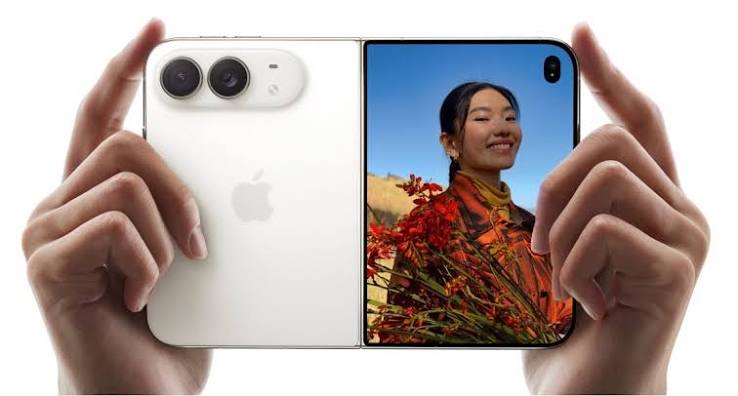
The rear system includes two 48 MP Fusion sensors, a main one and an ultra-wide. The Duo can record 4K at 120 fps in Dolby Vision on the main camera.
But the most interesting features are tied to the shape.
Duo Preview
The person being photographed can see the preview on the outer display.
Smart Take
On-device AI can analyse the scene and fire the shutter automatically when the subjects are positioned correctly.
Duo FaceTime
The outer display can be used to bring other people into a video call.
Selfie with the rear cameras
You can use the better rear sensors while controlling the framing from the outer display.
This is where the foldable becomes more than an extra display.
The shape creates new interactions.
Apple Pencil: a small detail with a large consequence
Apple also confirms compatibility with Apple Pencil USB-C later in the year.
And that slightly changes where the Duo sits.
Because a 7.6-inch phone that can show documents, take notes and use a stylus starts to look more like a productivity tool than a simple phone.
For a student or a mobile professional, that can be very interesting.
But for someone who never uses a stylus, this feature obviously does not by itself justify a price of 1 999 $.
The price: this is where our enthusiasm slows down
1 999 $ for 256 GB.
Then:
| Storage | Announced price in the United States |
|---|---|
| 256 GB | 1 999 $ |
| 512 GB | 2 199 $ |
| 1 TB | 2 599 $ |
| 2 TB | 3 199 $ |
Apple confirms these four storage capacities.
And there the problem becomes obvious.
From 1 999 $, the iPhone Duo is no longer an impulse buy.
It is a purchase you have to justify.
You really have to want the large display.
You really have to use the multitasking.
You really have to value the Apple ecosystem.
Otherwise a regular iPhone becomes much more rational.
PCMag reaches exactly that conclusion after its time with a Galaxy Z Fold: for its own use, it would rather have a traditional iPhone and keep several hundred dollars.
The real duel: iPhone Duo versus a regular iPhone
This may be a more relevant comparison than Duo versus Samsung.
| Criterion | iPhone Duo | High-end regular iPhone |
|---|---|---|
| Display | ⭐⭐⭐⭐⭐ | ⭐⭐⭐⭐ |
| Multitasking | ⭐⭐⭐⭐⭐ | ⭐⭐⭐ |
| Portability | ⭐⭐⭐ | ⭐⭐⭐⭐⭐ |
| Simplicity | ⭐⭐⭐ | ⭐⭐⭐⭐⭐ |
| Potential durability | ⭐⭐⭐⭐ | ⭐⭐⭐⭐⭐ |
| Productivity | ⭐⭐⭐⭐⭐ | ⭐⭐⭐⭐ |
| Photo | ⭐⭐⭐⭐ | ⭐⭐⭐⭐⭐ depending on the model |
| Gaming | ⭐⭐⭐⭐⭐ | ⭐⭐⭐⭐⭐ |
| Price | ⭐⭐ | ⭐⭐⭐⭐ |
| Wow factor | ⭐⭐⭐⭐⭐ | ⭐⭐⭐⭐ |
The Duo wins where a regular phone physically cannot compete:
display area.
The regular phone wins on almost everything that has to do with simplicity.
So is the iPhone Duo really better than Android foldables?
It is too early to say that for good.
But Apple arrives with a very interesting approach.
The maker is not only trying to win on thickness.
It is trying to control the whole experience :
the hardware, the hinge, the display, the processor, thermal management, the camera and, above all, iOS 27.
Tom’s Guide also reckons that the wait from Apple seems to have paid off on first impressions, while acknowledging that Samsung still holds some hardware advantages.
That is probably the best way to sum up where things stand.
Apple has not necessarily invented a new category.
It is trying to make the category mature enough to go mainstream.
But watch out for a trap: do not confuse “best foldable” with “best phone”
This is probably our main reservation.
A device can be the best foldable ever built…
…and still be a bad purchase for you.
If you:
- mainly use WhatsApp;
- make calls;
- watch Instagram;
- take a few photos;
- check your email;
- use Google Maps;
- watch YouTube;
- play occasionally;
then the 7.6-inch foldable display probably will not change your life.
If, on the other hand, your phone is also:
- your work tool;
- your reading screen;
- your notebook;
- your creation device;
- your mini tablet;
- your multitasking machine;
then the calculation changes completely.
Who does the iPhone Duo actually make sense for?
👨💼
The mobile professional
An excellent candidate. Documents, email, meetings, multitasking and presentations benefit directly from the large display.
🎓
The student
Very interesting. PDFs plus notes plus research plus Apple Pencil can turn the phone into a compact work tool.
🎥
The creator
Interesting, but it needs a real-world check. The framing and preview options are particularly appealing.
🎮
The gamer
Very interesting. The large display and the A20 Pro are a promising combination.
The everyday user
Not necessarily. And this is probably the group that should think hardest before buying.
Strengths of the iPhone Duo
✓
A real difference in use compared with a regular iPhone.
✓
The first hands-on sessions are particularly encouraging.
✓
Apple did not stop at changing the hardware.
✓
An architecture designed to hold performance.
✓
An important advantage for a foldable.
✓
An interesting way to use the internal space.
✓
The shape adds genuine extra possibilities.
✓
An extra argument for productivity.
The weak points
✗
That is a huge sum for a phone.
✗
The Duo is clearly not a light device.
✗
Physics remains physics.
✗
You can pay a lot for a feature you end up using very little.
✗
Apple‘s announcements are promising, but only months or years of use will really show how long the hinge and the inner display last.
✗
Apple provides the tools, but the final experience will also depend on developers.
Our Global Zone verdict
The iPhone Duo is impressive.
But it is not the price or the spec sheet that convinces us most.
It is how coherent the whole thing is.
Apple seems to have understood that the problem with a foldable phone is not simply making a display that folds.
The real problem is making sure the user wants to fold it and unfold it.
Early hands-on reports suggest Apple has pulled off part of this bet: the inner display is spectacular, the crease feels much less annoying to the touch, and iOS 27 makes the shape feel more natural.
But the experience of foldable owners recalls another reality: a large display is useful only when you actually need it.
That is why our verdict is deliberately nuanced.
⭐
💡
📱
⚙️
⚡
📷
🛡️
📦
💰
The verdict in one sentence
The iPhone Duo could become the best foldable for people who genuinely want a phone-tablet in their pocket — but at 1 999 $, it will take much more than the wow factor to convince regular iPhone users.
And that may, in the end, be the best thing that could happen to the foldable phone market.
Apple is not only coming to sell a foldable.
It is coming to ask the question that Samsung, Huawei and Xiaomi now have to face:
how many people actually want to live with a phone that folds?
FAQ — iPhone Duo
What is the price of the iPhone Duo?
The iPhone Duo starts at 1 999 $ in the United States with 256 GB. Apple also offers 512 GB, 1 TB and 2 TB versions, up to 3 199 $.
How big is the iPhone Duo display?
The outer display measures 5.4 inches and the inner display 7.6 inches.
Is the iPhone Duo water resistant?
It has an IP68 rating, according to Apple.
Which processor is in the iPhone Duo?
It uses the A20 Pro, the same processor announced for the iPhone 18 Pro models.
Does the iPhone Duo work with Apple Pencil?
Yes. Apple says it will support Apple Pencil USB-C later in the year.
When will the iPhone Duo be available?
Pre-orders start on 16 October 2026 and availability begins on 23 October 2026 in the first markets.
Should you buy the iPhone Duo?
Not automatically. If you really use its large display, the Duo can be extremely interesting. If you mainly use your phone as a regular smartphone, a traditional iPhone will probably be more rational and less expensive.
Also on GlobalZone
Samsung vs Apple: the foldable phone war
•Why should Samsung take the arrival of the iPhone Duo seriously?
•iPhone Duo vs Galaxy Z Fold8: what are the everyday differences?
Apple — Warranty, stock and after-sales support matter as much as iPhone Duo itself.
Avis des lecteurs
Votre avis compte
Partagez votre expérience et aidez d’autres lecteurs à mieux comprendre ce sujet.
Soyez le premier à donner votre avis.

