

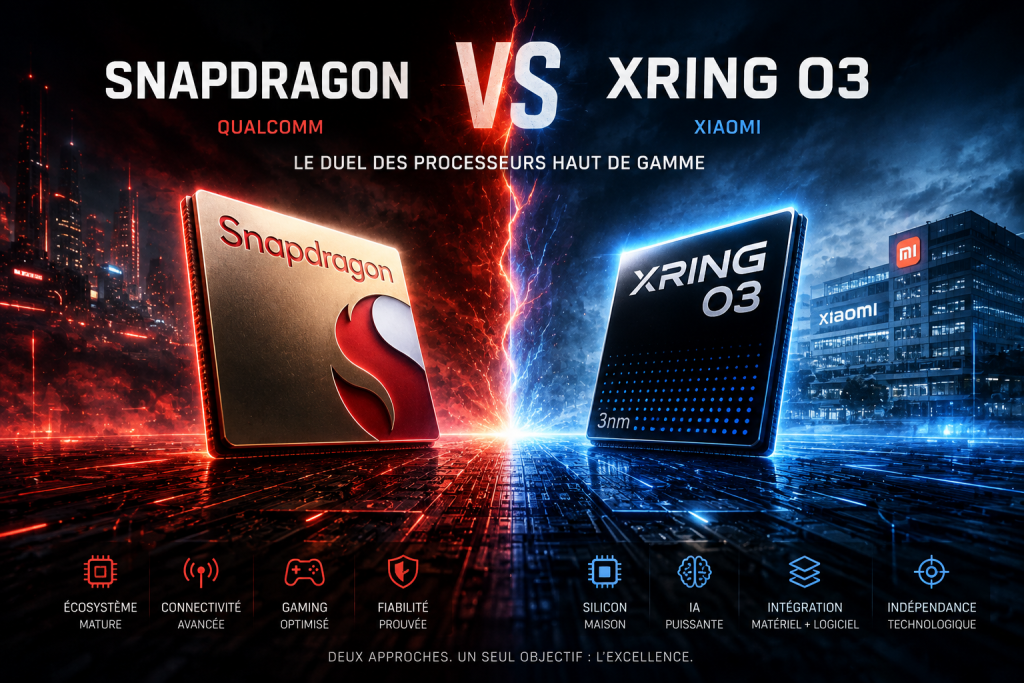
Snapdragon vs Xring: can Xiaomi really do without Qualcomm?
Listen to this article
Read aloud by your browser. No audio file is downloaded.
Spoken by your browser. This is not a recorded audio file. The time shown is an estimate.
If you are deciding now, keep Snapdragon vs Xring in view before the price or the spec sheet.
Xiaomi has just taken a new step in its in-house chip strategy with the Xring O3. But launching an ambitious SoC does not yet mean it can replace Qualcomm across an entire smartphone range. Here is what this battle actually changes for users.
Can Xiaomi really do without Qualcomm?
Not entirely, at least for now. The Xring O3 shows above all that Xiaomi wants to reduce its dependence on outside suppliers and take back more control over the essential components of its devices.
Before calling Xring the winner over Snapdragon, we will need to watch the performance of commercial devices, their battery life, their heat, their connectivity and, above all, the ability of Xiaomi to keep this technology going across several generations.
⚡
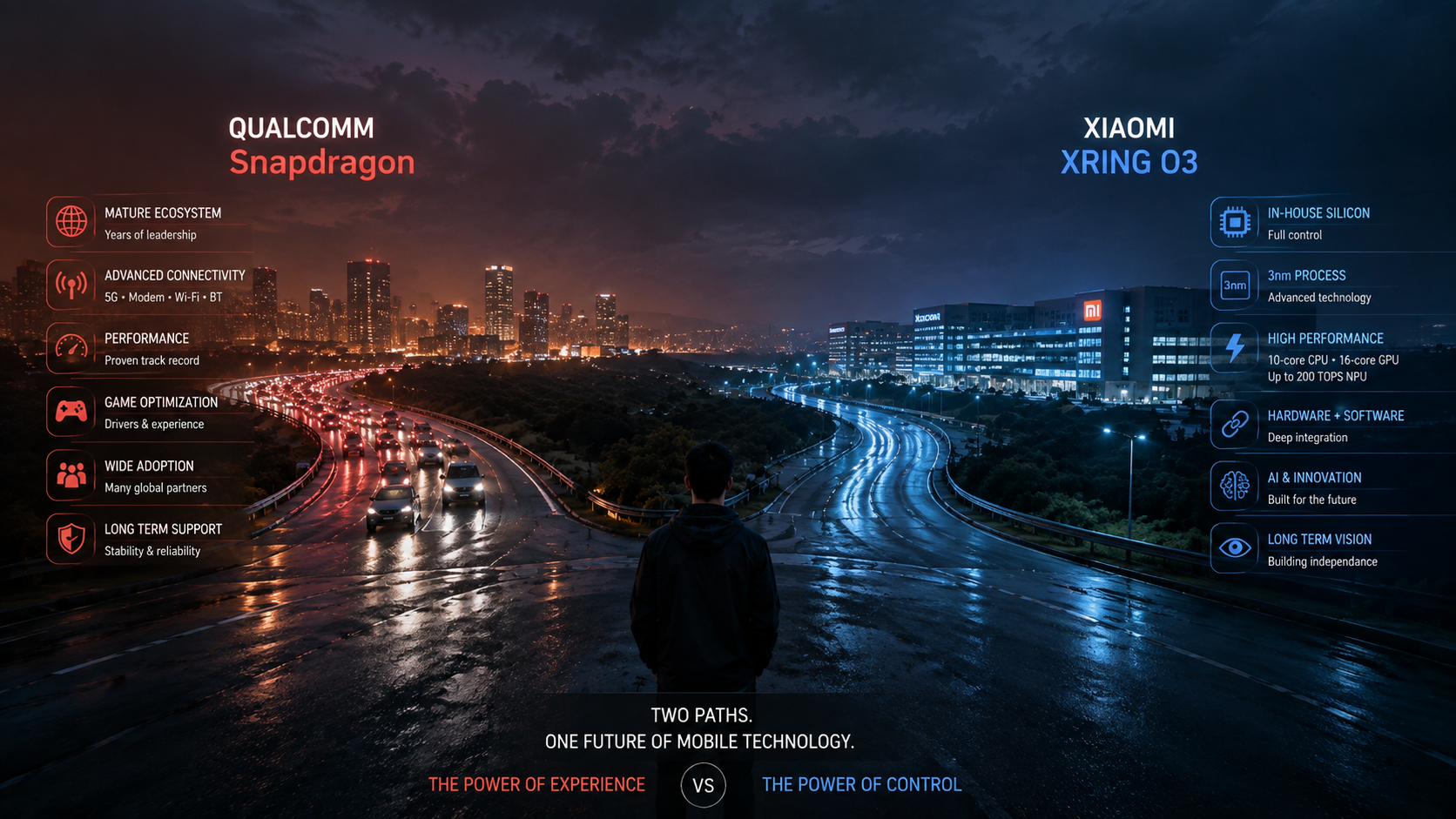
Xring O3 on 3 nm
The new flagship mobile SoC from Xiaomi is announced on a 3 nm process.
🧠
Up to 200 TOPS
The Xring O3 claims substantial power for artificial-intelligence workloads.
📱
🏆
Snapdragon is still very mature
Qualcomm keeps an important advantage through its experience, its ecosystem and its connectivity technologies.
The words to understand before comparing
Snapdragon
Snapdragon is the family of mobile platforms developed by Qualcomm. Depending on the generation, a Snapdragon can integrate the CPU, the GPU, artificial-intelligence accelerators and various connectivity technologies. Snapdragon therefore means a complete platform, not simply a processor.
Xring
Xring O3
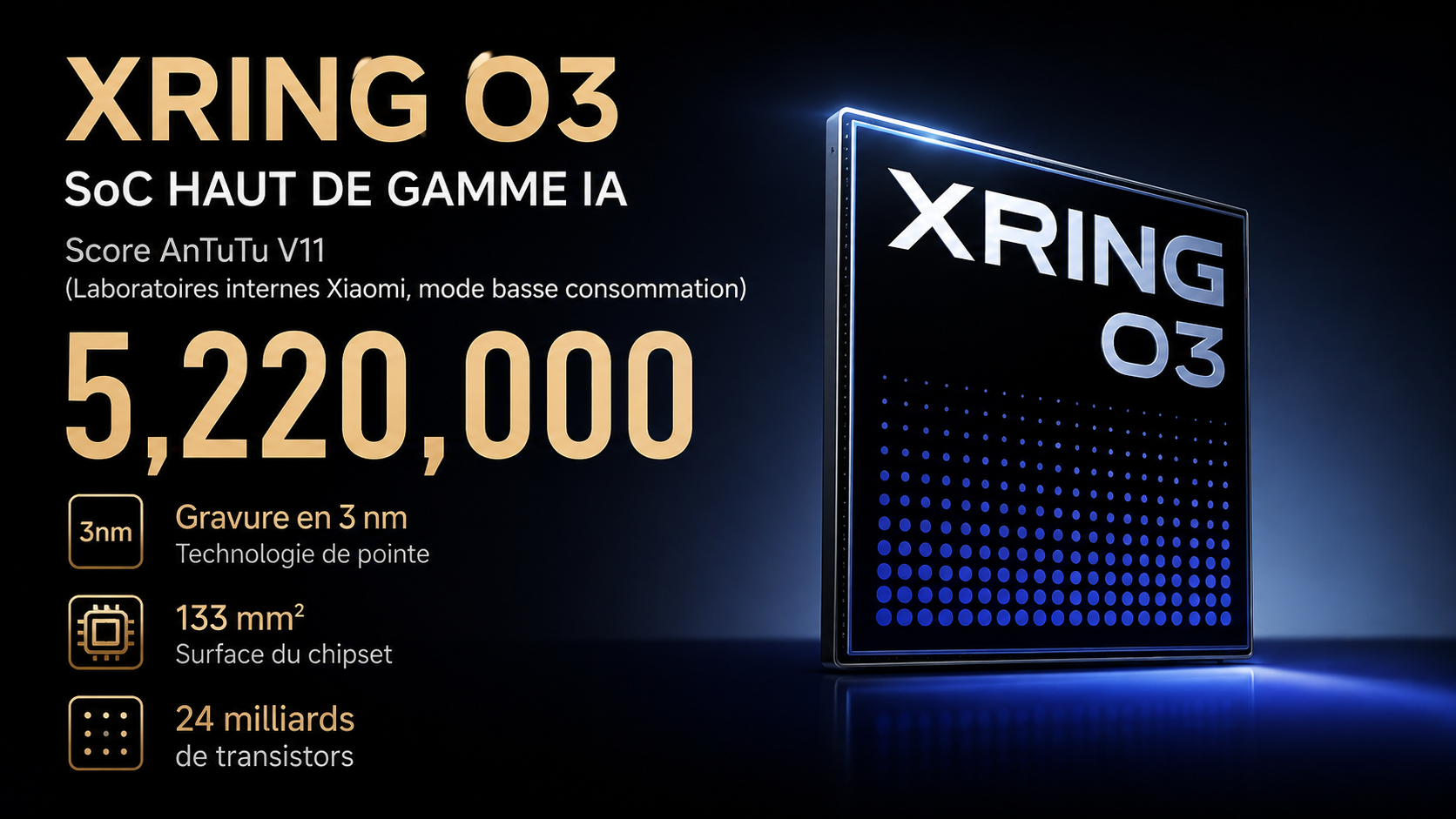
The Xring O3 is the new flagship mobile SoC from Xiaomi, announced in August 2026. It is presented as a chip built on 3 nm, combining a CPU, a GPU and AI acceleration in a single platform.
SoC (System on Chip)
A SoC brings together several essential parts of a device in one component: CPU, GPU, AI accelerators, memory controllers and, depending on the model, various connectivity functions. Comparing two SoCs therefore means comparing much more than a simple processor.
Qualcomm
Qualcomm is the American company that develops the Snapdragon platforms, among other products. It supplies its technologies to many smartphone makers and has a large ecosystem around mobile processors, connectivity and the related software.
NPU, GPU and CPU: what is the difference?
🧠
NPU
The NPU (Neural Processing Unit) is a unit specialised in calculations linked to artificial intelligence. It can run certain AI functions directly on the device, more efficiently than a general-purpose CPU.
🎮
GPU
The GPU (Graphics Processing Unit) is the processor specialised in graphics calculations. It plays an essential role in video games, 3D display and some parallel computing loads, including certain AI tasks.
⚙️
CPU
The CPU (Central Processing Unit) is the general-purpose processor of the SoC. It handles a large share of everyday tasks: applications, the system, browsing, multitasking and general calculations.
Xring O3: Xiaomi steps up a gear
On 24 August 2026, Xiaomi introduced the Xring O3, its new flagship mobile chip developed in-house. It is announced at 3 nm and is part of a strategy to give Xiaomi more control over its components and to reduce its dependence on outside suppliers.
Xiaomi had already launched the Xring O1 in 2025. The company is also developing the Xring O100 for artificial intelligence and the Xring D100 for autonomous driving.
Reuters reports that Xiaomi has invested more than 20 billion yuan in its chip business and that its semiconductor design team now exceeds 3,000 people.
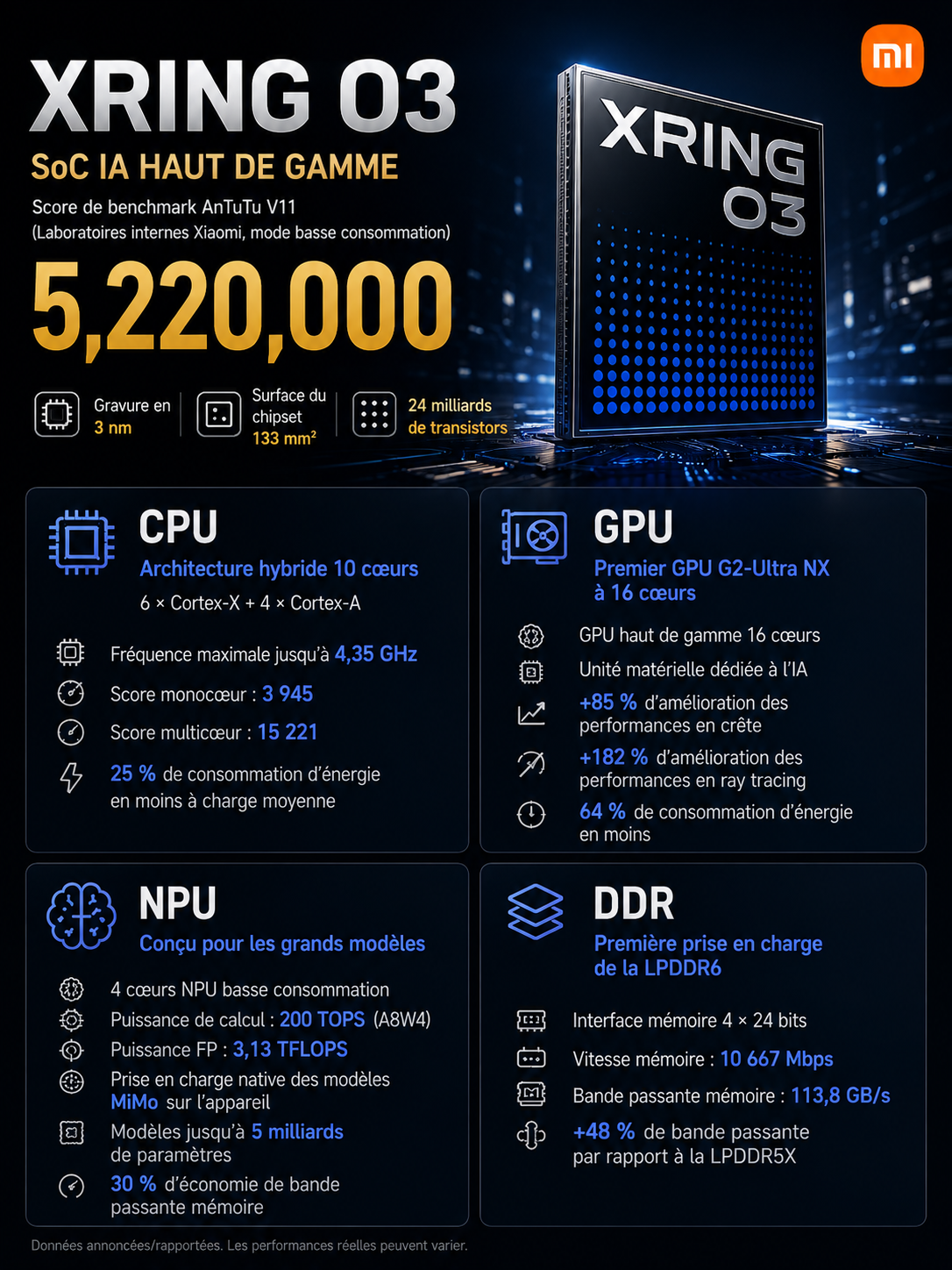
📊 Spec sheet: what we know about the Xring O3
| Item | Xring O3 |
|---|---|
| Manufacturing | TSMC, 3 nm |
| CPU | 10 cores, up to 4.35 GHz |
| GPU | 16-core G2-Ultra NX |
| AI | NPU announced at 200 TOPS |
| Memory | Announced LPDDR6 support |
| Memory bandwidth | Up to 113.8 GB/s |
| Transistors | 24 billion announced |
| AnTuTu | 5 228 014 |
| First expected device | Xiaomi 18 Fold |
| Other announced devices | Xiaomi Pad 9 Pro Max |
| Announced availability | September 2026 in China |
Several detailed specifications and benchmark scores are already circulating, but some of these figures come from presentations by Xiaomi or from secondary sources. Final performance should therefore be judged on commercial devices under comparable conditions.
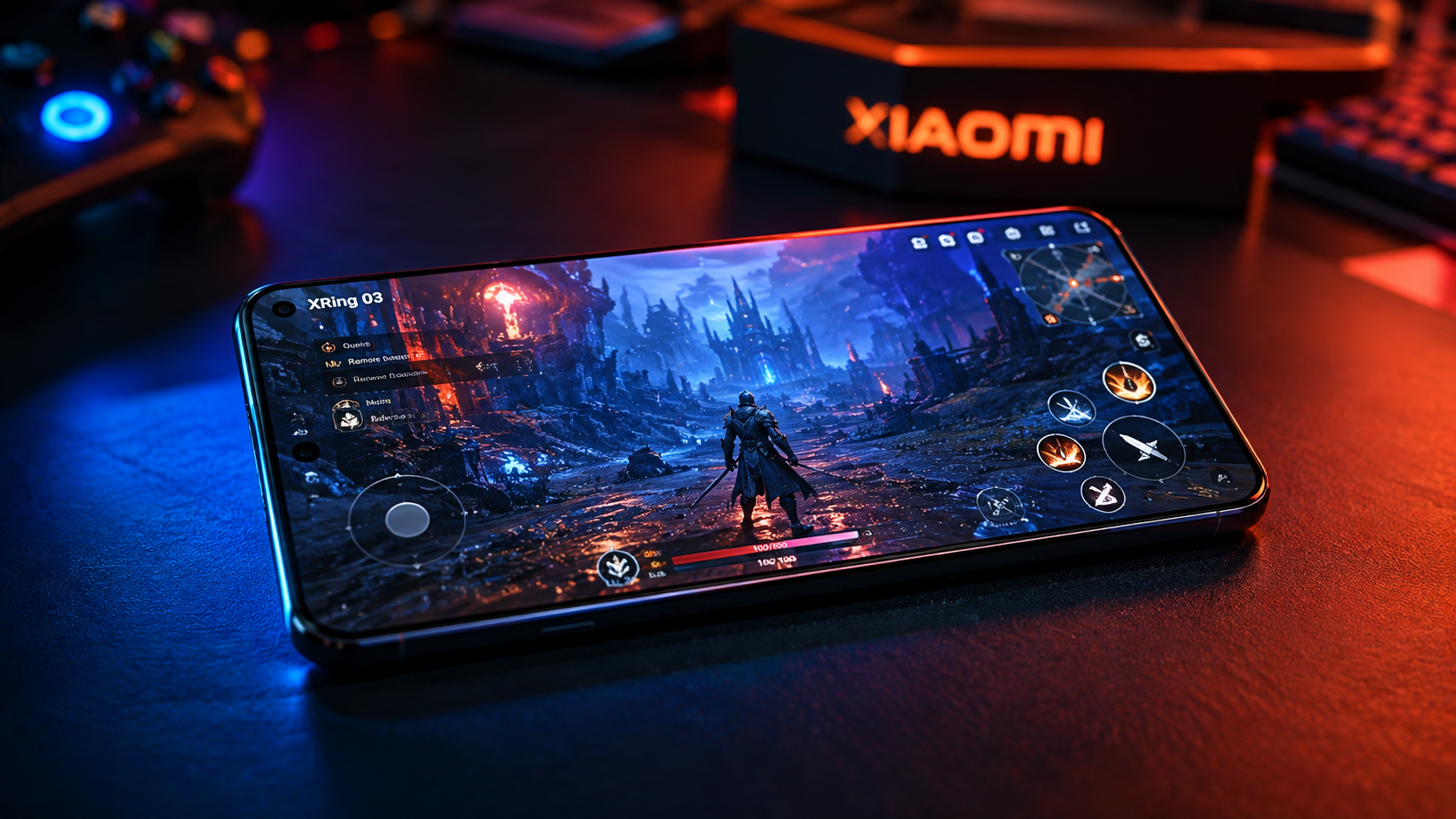
Snapdragon vs Xring: the real duel is not only about power
Comparing two SoCs with a single benchmark would be too simple. Qualcomm has a historical advantage through its ecosystem of platforms, modems, drivers, tools and partners. Xiaomi, for its part, wants to bring hardware and software closer together and gain more freedom over the features it wants to build into its devices.
| Criterion | Snapdragon / Qualcomm | Xring / Xiaomi | What to remember |
|---|---|---|---|
| Maturity | Very established ecosystem | In-house platform still young | Snapdragon advantage |
| Hardware control | Outside supplier | Xiaomi controls more of its SoC | Xring advantage |
| Software optimisation | Broad Android ecosystem | Direct optimisation with the Xiaomi ecosystem | Potential Xring advantage |
| Modem / connectivity | Qualcomm’s historical field | To be assessed device by device | No general verdict |
| AI | NPU and accelerators depending on generation | NPU announced at up to 200 TOPS | Figures not directly comparable |
| Gaming | Very mature drivers and optimisation | Very ambitious announced GPU | To be tested on a real device |
| Ecosystem | Very wide choice of manufacturers | Mainly tied to Xiaomi | Snapdragon advantage |
| Supplier dependence | Qualcomm remains an outside supplier | Xiaomi brings more in-house | Strategic Xring advantage |
Can Xiaomi really replace Qualcomm?
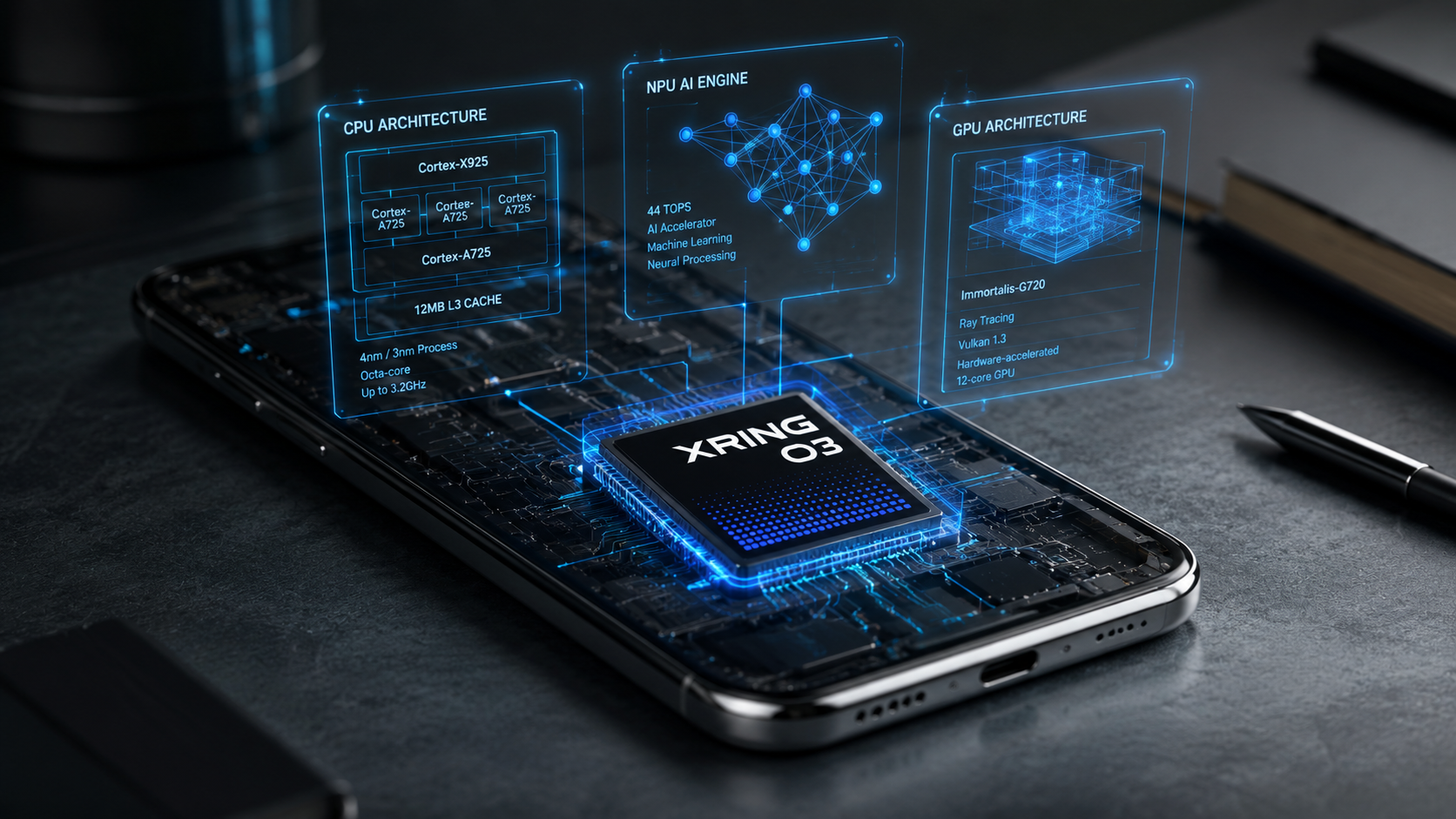
Two things should be kept separate. Replacing Snapdragon on some Xiaomi models is a real possibility. Xiaomi now has a second generation of in-house chips and says the Xring O3 has already entered mass production.
Replacing Qualcomm as the main supplier for the entire Xiaomi range is a much harder ambition.
The problem is not only designing a fast processor. Xiaomi has to sustain several generations, deliver competitive connectivity, optimise drivers and the system, support developers, manage volumes and offer a stable experience across different devices.
In other words, the Xring O3 can reduce Xiaomi’s dependence on Qualcomm without meaning that Qualcomm will disappear from its catalogue.
Qualcomm’s real advantage: the ecosystem
A Snapdragon is not just its CPU and GPU cores. Qualcomm supplies a complete platform around the SoC, with connectivity technologies, drivers, software tools and long experience with many manufacturers.
That is exactly the difficulty for Xiaomi: making an excellent chip is one step; building an equally robust ecosystem around it is another.
But Xiaomi has an advantage Qualcomm does not have in the same way: it directly controls its smartphones, its software and a growing share of its hardware. That can let it fine-tune certain proprietary features more closely.
Xring O3: is it already better than a Snapdragon?
The honest answer is: we cannot yet say so in general.
On paper, the Xring O3 posts impressive figures, notably its 3 nm process, its 10-core CPU, its 16-core GPU, its LPDDR6 support and the performance Xiaomi has announced.
But comparing a manufacturer score with an independent benchmark of a different Snapdragon, tested on another phone, does not produce a reliable winner.
For a real comparison, the same benchmarks, comparable software versions, controlled temperatures and commercial devices are needed. Only then can we judge sustained performance, power use and heat.
Gaming: the benchmark does not tell the whole story
A processor can post a spectacular score and then lose part of that advantage after several minutes of play if the phone heats up or lowers its frequency.
For gaming, we will therefore need to look at sustained FPS, stability, temperature, power use, graphics drivers and game optimisation.
The Xring O3 looks promising, but its gaming verdict has to wait for tests of commercial devices.
AI: is 200 TOPS really huge for the user?
The Xring O3 claims up to 200 TOPS of tensor performance. That is an interesting figure, but it should not automatically be turned into “better AI”.
A more powerful NPU does not by itself guarantee a better experience. The models used, the memory, the software, HyperOS optimisations and application compatibility also play a decisive role.
This is precisely one of Xiaomi’s strategic lines. Alongside the Xring O3, the company is developing the Xring O100 to support its artificial-intelligence features and the Xring D100 for autonomous driving.
The Xring O3 and future Xiaomi devices
The Xring O3 should not stay limited to a single product. The information around the announcement indicates that it is due to power the Xiaomi 18 Fold and the Xiaomi Pad 9 Pro Max, with launches planned in China in September 2026.
This step matters: the more Xiaomi deploys its SoC across different devices, the more it can test the architecture in varied uses and build a real ecosystem around Xring.
The Xring O3 in Morocco: should you wait for it already?
For a buyer in Casablanca, Rabat, Tangier, Marrakech, Fès, Agadir, Meknes or Oujda, the question will not only be whether the Xring O3 is powerful.
The exact product version and its destination market will need checking.
Before an imported purchase, check in particular network-band compatibility, software services, language and available apps, the warranty, after-sales service, spare parts, accessories and return conditions.
Official availability in Morocco will also need to be confirmed before drawing a conclusion on value for money.
For someone who simply wants a reliable smartphone today, a mature Snapdragon model can remain a very solid choice. For someone who wants to discover Xiaomi’s new generation of hardware, the Xring O3 clearly deserves to be watched.
The real stake: Xiaomi wants to take back control
The Xring O3 does not announce the end of Qualcomm at Xiaomi. It marks a strategic shift: Xiaomi wants more control over the components that determine performance, AI, imaging and the software experience of its devices.
In the short term, the most credible scenario is coexistence: Xring on certain strategic products, Snapdragon or other platforms when Xiaomi sees an advantage.
In the long term, if Xiaomi manages to improve its chips generation after generation and deploy them widely, its bargaining power with suppliers could grow.
The Snapdragon vs Xring duel is therefore not only a benchmark race. It is a battle for technological control.
❓ FAQ — Snapdragon, Xring O3 and Xiaomi
Is the Xring O3 better than Snapdragon?
Not yet in general. The announced specifications are promising, but a reliable comparison needs independent tests on commercial devices under identical conditions.
What is the AnTuTu score of the Xring O3?
Xiaomi announces a score of 5 228 014. It should be treated as a manufacturer figure until it is confirmed by comparable independent tests.
Which devices will use the Xring O3?
The available information mentions in particular the Xiaomi 18 Fold and the Xiaomi Pad 9 Pro Max, with announced availability in China from September 2026.
Is the Xring O3 good for gaming?
It looks promising on paper, but real gaming performance will depend on cooling, drivers, optimisation and sustained performance.
Is the Xring O3 better for AI?
It claims up to 200 TOPS, but the number of TOPS is not enough to judge an AI experience. The models, the software, the memory and compatible applications also count.
Can Xiaomi replace Qualcomm?
Xiaomi can gradually reduce its dependence on Qualcomm on some devices. Replacing Qualcomm as the main supplier for its entire range is a much more ambitious step.
Will the Xring O3 be available in Morocco?
Official availability in Morocco should not be assumed until Xiaomi has confirmed it. For an imported model, check the version, the networks, the warranty and after-sales service.
Should you choose Snapdragon or wait for Xring?
For an immediate purchase, choose above all according to the whole phone: sustained performance, battery life, camera, software, network and support. For future Xiaomi Xring devices, it is better to wait for independent tests.
In brief
📱
Snapdragon
Mobile platform developed by Qualcomm.
⚙️
Xring
Family of chips developed by Xiaomi.
🧠
Xring O3
New flagship mobile SoC developed in-house by Xiaomi.
🔬
SoC, NPU, GPU and CPU
The main elements for understanding and comparing modern mobile platforms.
Our verdict
The Xring O3 is an important step for Xiaomi, but its interest is not summed up by an AnTuTu score. Real success will mean turning an ambitious in-house chip into a reliable, efficient, well-optimised platform deployed across several generations.
Qualcomm still holds a considerable advantage in maturity and ecosystem today. Xiaomi, for its part, is gradually gaining control.
That difference is what makes the Snapdragon vs Xring duel interesting: the next chapter will not be played on power alone, but on Xiaomi’s ability to master the whole experience around its chip.
To remember
- The Xring O3 is the new flagship mobile SoC developed in-house by Xiaomi.
- It is announced at 3 nm and is due to power the Xiaomi 18 Fold and the Xiaomi Pad 9 Pro Max, among other devices.
- Xiaomi wants to reduce its dependence on outside suppliers.
- Snapdragon keeps an important advantage through its ecosystem and its maturity.
- The announced Xring O3 benchmarks still need to be confirmed in independent tests.
- For the user, the best chip is not necessarily the one with the best score: battery life, heat, network, software and support also count.
Sources and method
The strategy and investment points are based in particular on information reported by Reuters on 24 August 2026. The technical information comes from material published around the Xring O3 announcement in August 2026.
The performance figures announced by Xiaomi are presented as such and are not treated as independent measurements.

Qualcomm — Warranty, stock and after-sales support matter as much as Snapdragon vs Xring itself.
A careful look at Snapdragon vs Xring avoids paying for a feature you will not use.
Global Zone customers usually ask about Snapdragon vs Xring when they compare two close options.
Treat Snapdragon vs Xring as one criterion next to battery life, noise, weight and updates.
Nothing in Snapdragon vs Xring replaces checking the exact model number on the box.
For a shop in Morocco, Snapdragon vs Xring should be read together with local availability.
If you are deciding now, keep Snapdragon vs Xring in view before the price or the spec sheet.
The useful reading of Snapdragon vs Xring is what changes for a buyer in Morocco, not the slogan.
Warranty, stock and after-sales support matter as much as Snapdragon vs Xring itself.
A careful look at Snapdragon vs Xring avoids paying for a feature you will not use.
Global Zone customers usually ask about Snapdragon vs Xring when they compare two close options.
Treat Snapdragon vs Xring as one criterion next to battery life, noise, weight and updates.
Nothing in Snapdragon vs Xring replaces checking the exact model number on the box.
For a shop in Morocco, Snapdragon vs Xring should be read together with local availability.
If you are deciding now, keep Snapdragon vs Xring in view before the price or the spec sheet.
Avis des lecteurs
Votre avis compte
Partagez votre expérience et aidez d’autres lecteurs à mieux comprendre ce sujet.
Soyez le premier à donner votre avis.

