

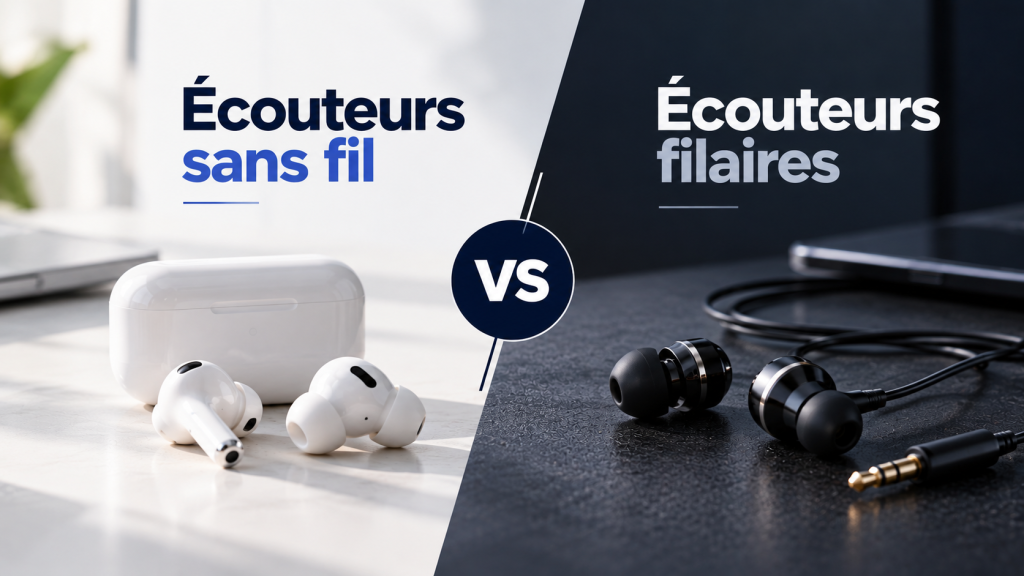
Wireless vs wired headphones: does the wired comeback really change anything?
Listen to this article
Read aloud by your browser. No audio file is downloaded.
Spoken by your browser. This is not a recorded audio file. The time shown is an estimate.
If you are deciding now, keep headphones in view before the price or the spec sheet.
For several years, the cable seemed doomed to disappear.
The headphones without a cable have become a symbol of modernity: you open a case, they connect, you put them in your ears and almost forget they are there. No more cable in a pocket, no more wire catching on clothes, and more and more features such as active noise cancellation, transparency mode and spatial audio.
But in 2026, a rather unexpected trend is drawing attention.

The headphones with a cable are coming back.
Not only among a few technology enthusiasts. They are showing up again in fashion, in creator content, on the street and especially in the looks of certain celebrities. Lily-Rose Depp, Gigi and Bella Hadid, Zoe Kravitz and Emily Ratajkowski have been photographed wearing headphones with a cable. Dua Lipa even showed several pairs in a Vogue video.
The phenomenon is visible enough that the audio industry is starting to react as well.
But be careful: this does not mean everyone is giving up Bluetooth.
The return of wired listening tells a more interesting story: the headphones without a cable and wired headphones reflect two different philosophies of audio.
One favors freedom.
The other favors simplicity.
And between the two, the best choice depends above all on how you listen.
The return of headphones with a cable: simple nostalgia or a real trend?
For a long time, wearing headphones with a cable almost felt like using outdated technology.
Then fashion started to change.
Accessories inspired by the 2000s came back, Y2K style settled into popular culture, and objects once seen as ordinary became fashion pieces again.
The headphones with a cable fit this logic perfectly.

The cable on show can now be a deliberate choice.
It becomes an accessory.
It can complete an outfit, recall an era, or simply give a more “authentic” look.
But fashion is not the only argument.
Wired listening also has very concrete strengths:
- no battery to charge;
- direct connection;
- generally very low latency;
- instant use;
- no Bluetooth pairing;
- no case to carry;
- often an affordable price;
- potentially long listening time.
It is precisely this mix of nostalgia, looks and usefulness that makes the wired comeback interesting.
And the phenomenon is no longer only cultural: in September 2026, Bose announced new headphones with a cable and USB-C, plus active noise cancellation, after more than a decade without a new wired model of this kind from the brand. Market data cited by several outlets also point to a recovery in wired headphone sales in 2025-2026.
Wired listening may therefore no longer be only a memory of an older generation.
Headphones without a cable: how did they become the norm?
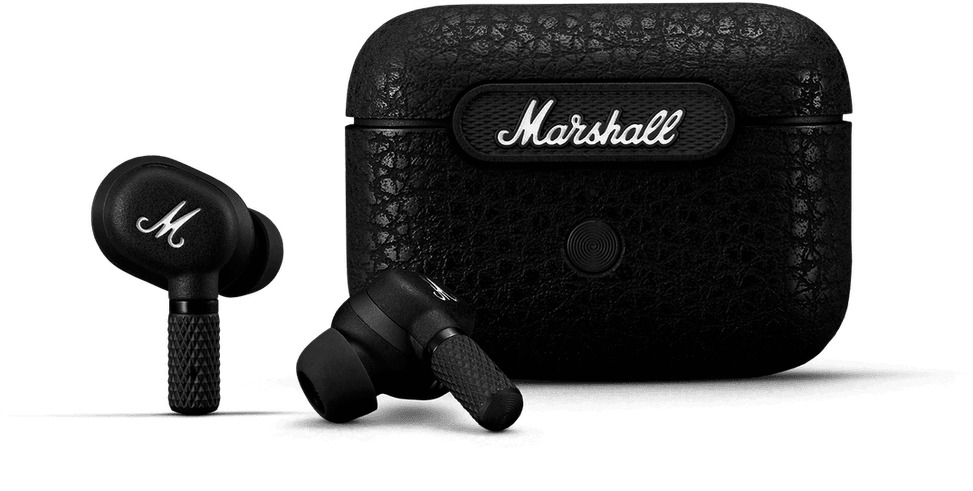
To understand the wired comeback, you first need to understand why wireless gained so much ground.
The idea is simple.
The headphones use a Bluetooth connection to receive audio from a smartphone, a computer, a tablet or another compatible device.
Each earpiece usually has:
- a battery;
- a Bluetooth system;
- one or more speakers;
- microphones;
- control electronics;
- sometimes several sensors.
They usually come with a case that is both storage and a charger.
This design allows something wired headphones cannot offer as easily:
total freedom of movement.
You can walk, run, take the metro, work or make calls without a cable attached to your smartphone.
That freedom explains a large part of the success of True Wireless Stereo, or TWS.
Headphones with a cable: an older technology that still has real advantages
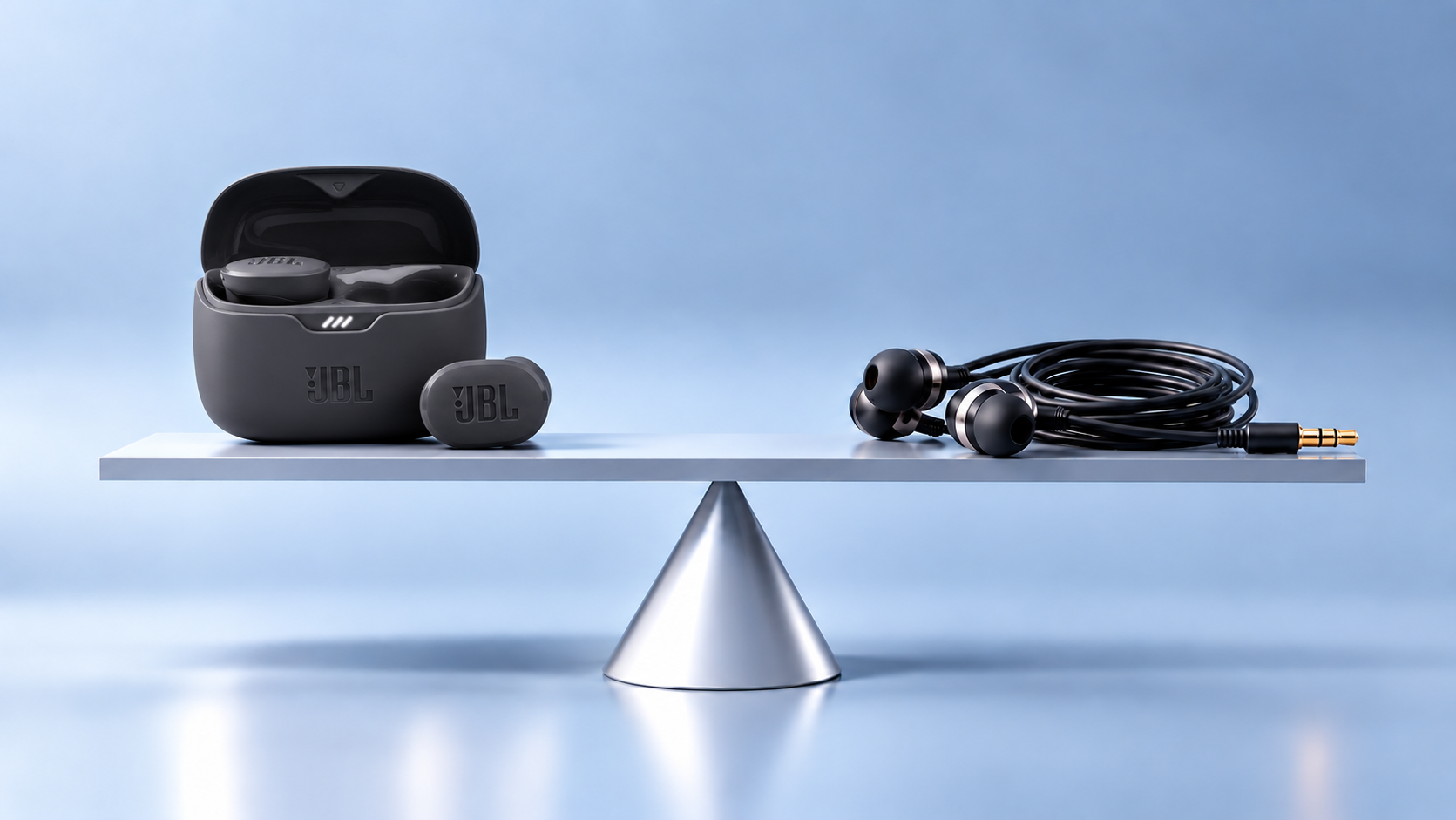
At first glance, the headphones with a cable look much simpler.
And that is exactly their strength.
They generally do not need:
- a battery;
- a charging case;
- pairing;
- an app;
- a Bluetooth connection.
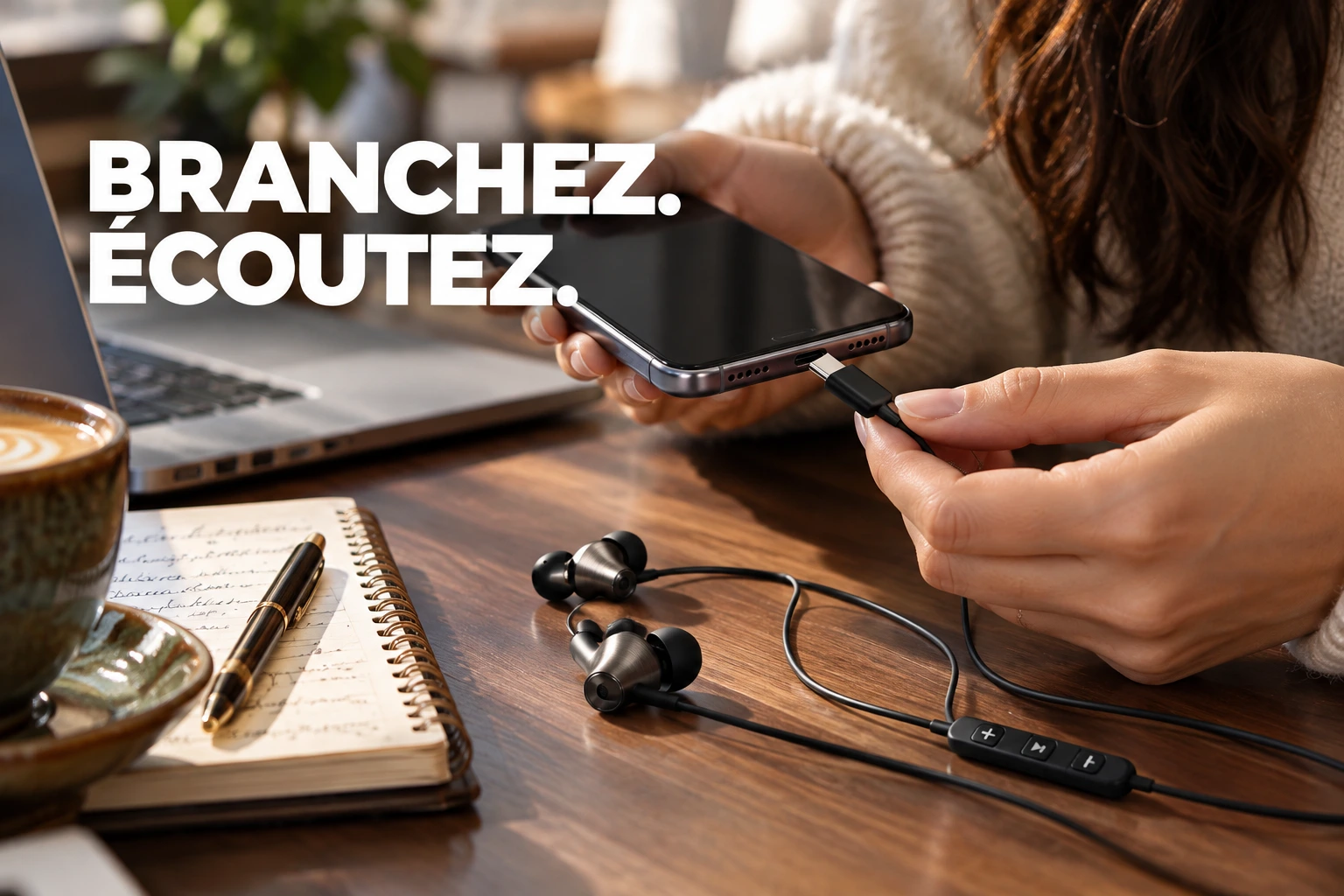
This simplicity can seem almost archaic in the age of voice assistants and smart noise cancellation.
But it becomes very useful in some situations.
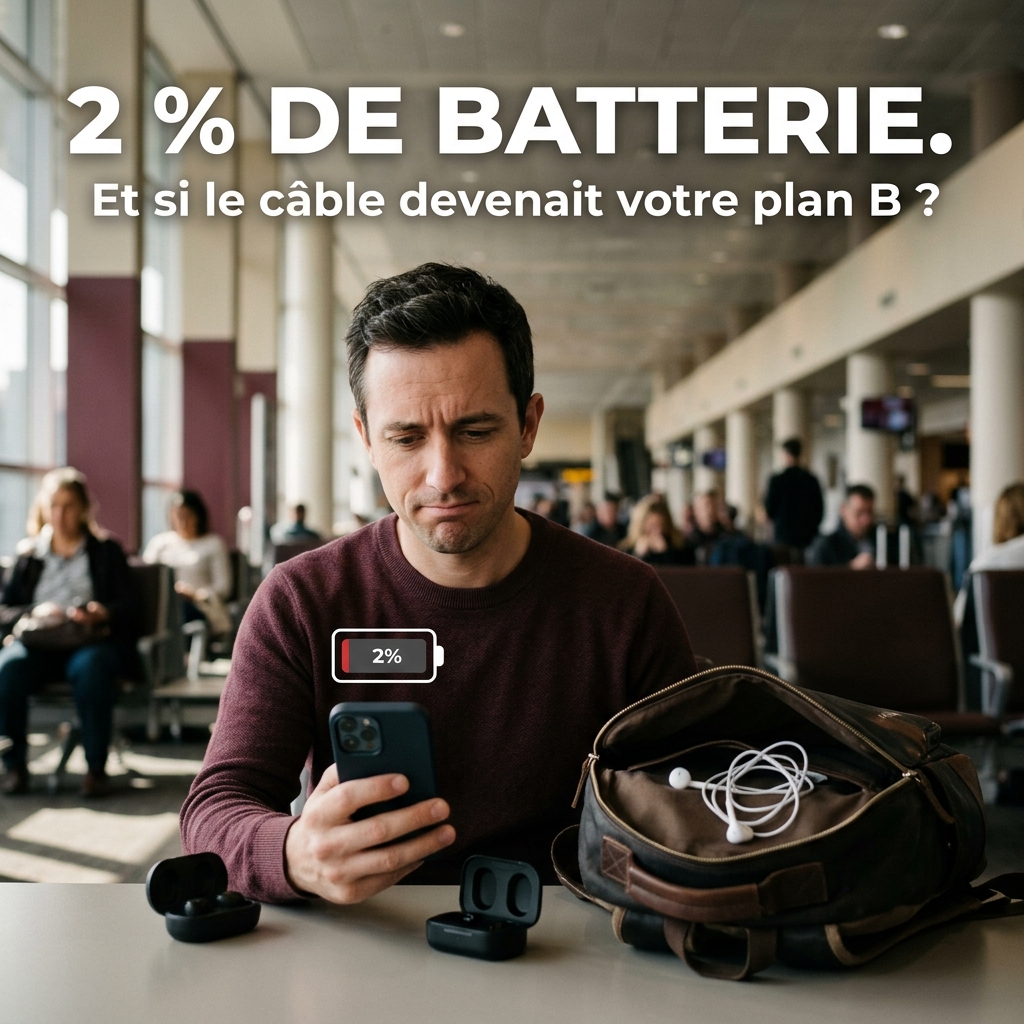
Imagine you are away from home and your headphones without a cable show 2 % battery.
Your phone is charged.
Your internet connection works.
But your headphones are unusable.
With a wired model, that problem simply does not exist.
Sound quality: are wired headphones really better?
This is probably the most complicated question in the whole debate.

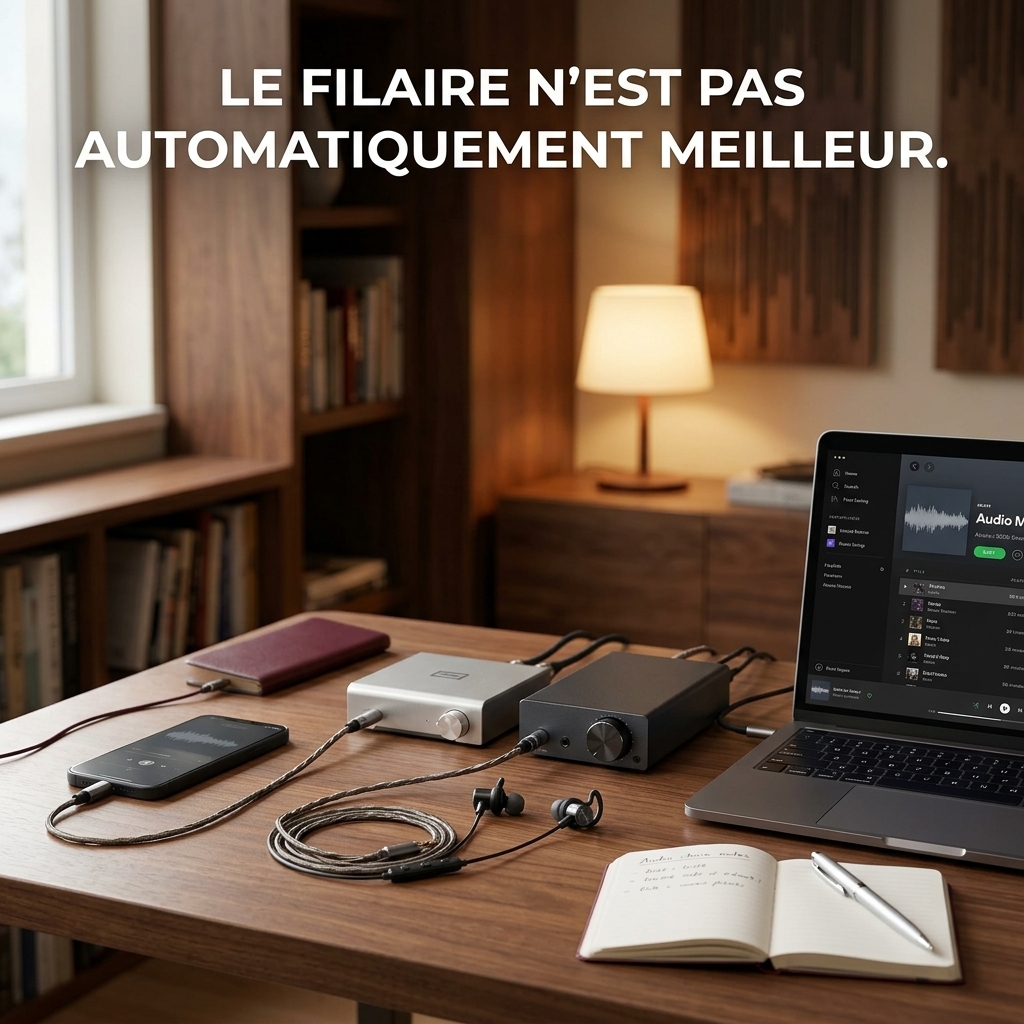
The short answer is: not automatically.
Saying that all headphones with a cable produce better sound would be wrong.
A cheap wired earphone can perform far worse than an excellent Bluetooth model.
Sound quality depends on many things:
- driver quality;
- acoustic design;
- amplification;
- digital-to-analog conversion;
- equalization;
- the quality of the recording;
- the codec used for Bluetooth;
- software processing;
- isolation from outside noise.
A very good wireless earphone can therefore deliver a remarkable listening experience.
But wired headphones have an important trait: they do not need to send the sound over a Bluetooth link.
That can matter especially to listeners who want a more direct audio chain, or who use an external DAC or amplifier.
Bluetooth: the technology has come a long way
It would also be unfair to compare today’s headphones that use a cable with the first Bluetooth earphones.
Bluetooth audio has improved enormously.
Bluetooth LE Audio notably introduces the LC3 codec, designed to improve efficiency and sound quality while using less power. The technology also adds features such as multi-stream and Auracast.
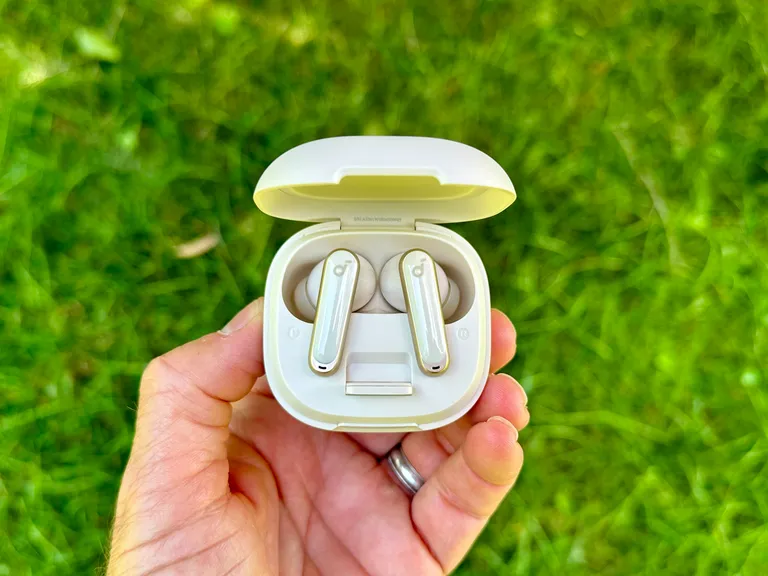
This means modern Bluetooth is far from being only a “convenient but inferior” solution.
It has become a real audio platform.
So the debate is no longer:
Reality is much more complex.
Latency: wired still leads, but wireless is catching up
Latency is the delay between an action and the moment you hear the matching sound.
To listen on Spotify, watch Netflix or chat on WhatsApp, low latency is usually enough.
But in some situations it becomes much more important.
Gaming
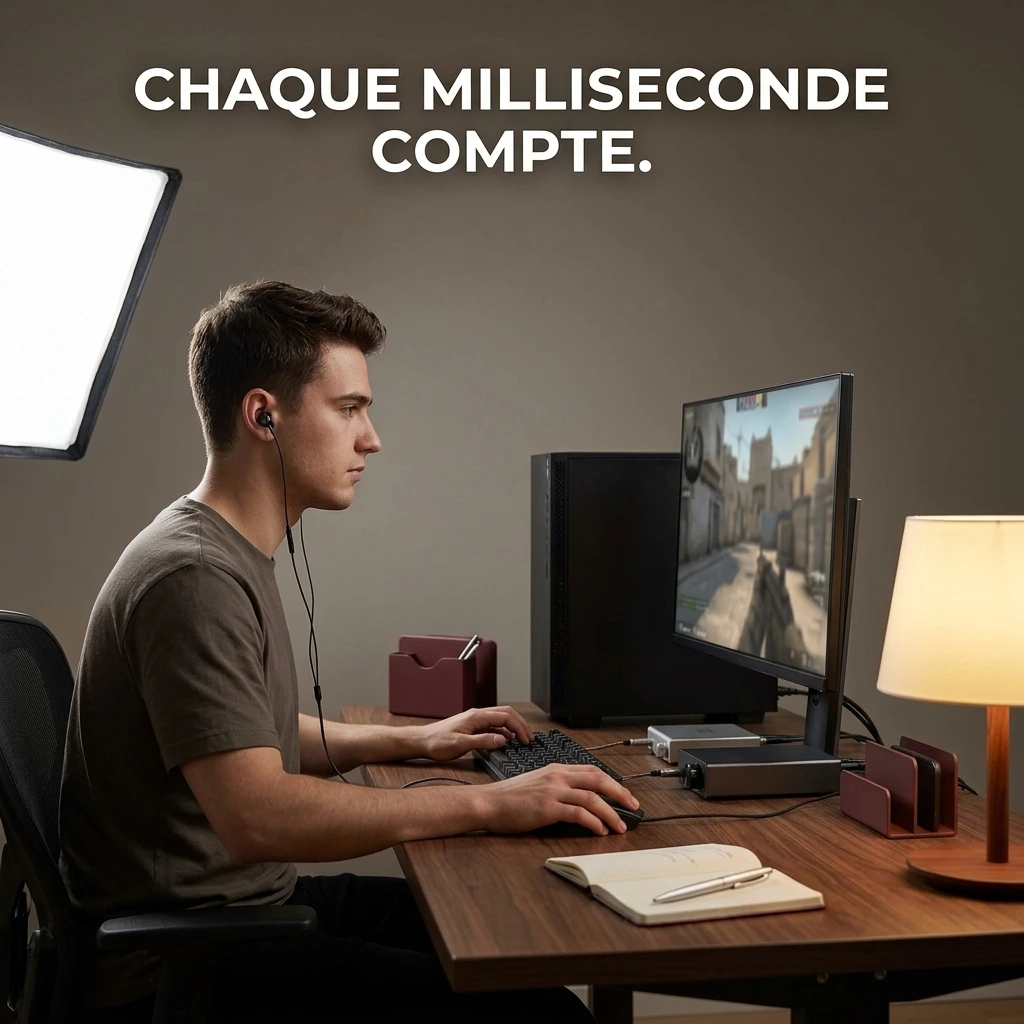
Imagine a competitive game.
An opponent walks behind you.
The sound arrives slightly after the action.
A tiny difference can become noticeable.
That is why headphones with a cable stay popular with some players.
They offer a direct connection and very low latency.
But the headphones without a cable are not out of the running.
Many recent models offer low-latency game modes.
The choice therefore depends on the model and the type of game.
ANC: the big advantage of headphones without a cable
Active noise cancellation, or ANC, is probably one of the technologies that has most changed the headphones of today.
It uses microphones to analyze the sounds around you and generate a signal that reduces part of the outside noise.
It is especially useful:
- on a plane;
- on a train;
- on a bus;
- in an open-plan office;
- in a cafe;
- on a very busy street.
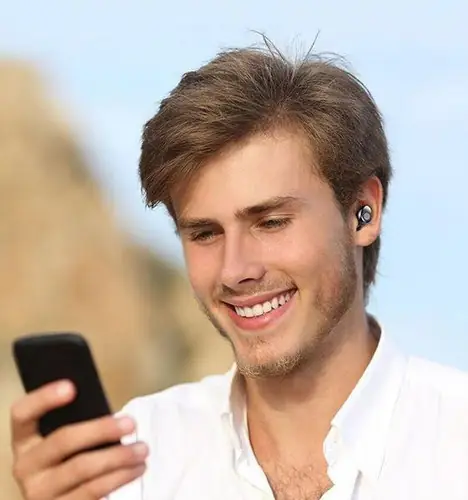
The headphones with a cable can offer excellent passive isolation.
But when it comes to sophisticated ANC, the headphones without a cable now hold a very important place.
And this technology has another benefit: it can keep you from turning the volume up too high in noisy places.
WHO notably recommends using headphones that fit well and, when it is appropriate, noise cancellation, so you do not need to raise the volume in noisy environments.

Battery: the Achilles heel of wireless
This is one of the most important compromises.
The headphones without a cable have to be recharged.
That means their listening time depends in particular on:
- the capacity of the small batteries;
- the age of the batteries;
- listening volume;
- ANC;
- calls;
- connection quality;
- how often you use them.
The case usually provides several extra charges.
But the case itself has to be charged too.
headphones → battery → case → charging.
It is extremely convenient when everything works.
But it also adds a constraint that did not exist with headphones that are wired.
And after two or three years?
This is where the comparison gets especially interesting.
A wired earphone can keep working for a long time as long as the cable and the components stay in good condition.
A wireless model has a tiny battery.
Over time, that battery can lose capacity.
The earphone still works.
But it can drop from several hours of battery life to a much shorter time.
Repairability is therefore a real subject.
For some buyers, choosing a simpler device can make more sense than regularly replacing a product whose battery is no longer enough.
Comfort: impossible to name a winner
Comfort is probably the area where a universal answer is hardest.
Some people hate cables.
Others hate headphones that fall out of their ears.
Some people like headphones that sit open on the ear.
Others prefer in-ear models.
Some find TWS lighter.
Others like the stability of a wired model.
Comfort therefore depends on:
- the shape of the ear;
- the weight;
- the ear tips;
- how well they stay in place;
- the cable length;
- the pressure they apply;
- the type of use.
An earphone that is perfect for one person can be extremely uncomfortable for another.
Sport: wireless has an obvious advantage
For running, cycling or the gym, the absence of a cable is a very concrete advantage.
No cable catching on your clothes.
No cable pulling on your ears.
No cable swinging around your neck.
Sports models can also offer:
- water resistance;
- sweat resistance;
- stability fins;
- transparency modes;
- touch controls.

For this kind of use, wireless is especially appealing.
But wired wins on one point: it cannot run out of battery
Imagine two users.
The first has a premium pair of TWS headphones.
The second has a basic wired pair.
After a day at work, the first has to recharge the headphones.
The second just plugs in.
That is all.
That small detail explains why some people deliberately keep a wired pair in their bag.
It becomes a kind of technology backup plan.
Calls and microphones: modern wireless takes the lead
The headphones in recent TWS models include several microphones and voice-processing algorithms.
They can try to separate the user voice from the noise around them.

That becomes especially useful for:
- work calls;
- video meetings;
- WhatsApp;
- Teams;
- Zoom;
- calls on public transport.
But do not treat every model as equal.
A Bluetooth earphone at 150 DH and a premium model will obviously not offer the same microphone quality.
As always:
And where do the celebrities fit into this?

This is probably one of the most surprising sides of the phenomenon.
For several years, headphones without a cable had become almost impossible to avoid in celebrity photos.
Then wired headphones started to show up again.
You see them on stars such as Lily-Rose Depp, Gigi and Bella Hadid, Zoe Kravitz and Emily Ratajkowski.
Dua Lipa also showed several pairs of wired headphones in a Vogue video.
This detail can seem anecdotal.
But fashion works precisely through signals like these.
An object can move from:
without its technology changing.
Wired headphones benefit from that shift today.
Why do celebrities wear headphones with a cable?
It would be impossible to give a single reason for all of these people.
Several explanations exist.
1. Style
The cable is visible.
And what used to be a flaw sometimes becomes a style detail.
2. The Y2K comeback
The headphones with a cable belong to a cultural period that many younger people are rediscovering.
3. Simplicity
No need to think about battery life.
4. The music
For some listeners, a wired connection stays interesting when they want direct listening and minimal latency.
5. The anti-tech effect
In a world full of screens, apps, notifications and connected devices, a simple accessory can become a statement.
I just want to listen to music.
But be careful: celebrities do not prove that wired replaces wireless
This point is essential.
The fact that some celebrities wear headphones with a cable does not mean the market is abandoning wireless headphones.
You have to separate:
Wireless remains extremely practical.
The wired comeback looks more like a wider range of uses, and a cultural phenomenon that also comes with real technical advantages.
Headphones with a cable vs wireless: the full comparison
| Criterion | Headphones with a cable | Headphones without a cable |
|---|---|---|
| Freedom of movement | Average | Excellent |
| Sound quality | Excellent, depending on the model | Excellent on the best models |
| Latency | Very low | Variable |
| Battery | Not needed in most cases | Required |
| Charging | No | Yes |
| ANC | Possible, but less common | Very widespread |
| Sport | Fair | Excellent |
| Gaming | Excellent | Very good on some models |
| Calls | Depends on the microphone | Very good on recent models |
| Simplicity | Excellent | Excellent after setup |
| Pairing | None | Required |
| Durability | Potentially high | Depends in particular on the battery |
| Repairability | Generally simpler | Often more complex |
| Carrying | Simple | Case required |
| Entry price | Often very affordable | Highly variable |
| Style | Trendy comeback / retro | Modern |
| Professional audio use | Very interesting | Very practical, but it depends on the context |
| Sport | Cable potentially annoying | Very practical |
| Travel | Good | Excellent |
| Audiophile listening | Very wide choice | Major progress |
| Dependence on a battery | No | Yes |
For music: which should you choose?

If your priority is simply to listen to music, both technologies can fit perfectly.
But your habits make the difference.
Do you listen mainly at home?
Wired can be a good option.
Do you listen mainly on public transport?
Wireless with ANC becomes especially interesting.
Are you passionate about music?
Wired deserves a serious look, especially if you use a DAC or dedicated audio gear.
Do you mainly listen to Spotify on your smartphone?
A good TWS pair can be extremely satisfying.
For gaming
The choice becomes more nuanced.
Wired
Advantages:
- very low latency;
- no battery;
- direct connection;
- simplicity.
Wireless
Advantages:
- freedom of movement;
- no cable;
- some models offer a low-latency mode;
- better mobility.
For a competitive player, latency and stability can tip the balance toward wired.
For a casual player, a good wireless model can be a perfect fit.
For work
Wireless has an obvious advantage.
You can switch easily from your phone to your computer, depending on the model.
headphones today can also offer a multipoint connection, so you can manage several devices.
Wired remains useful if you need a simple, permanent solution for a computer.
For students
A student can have very different needs:
- online classes;
- music;
- YouTube;
- commuting;
- calls;
- gaming;
- revision.
In that case, wireless can be very practical.
But a small wired pair can also be kept as a backup.
That is especially useful so you are not left without audio when the battery is empty.
For content creators
For creators, the choice depends on the stage of production.
Wireless is practical for:
- listening to a video;
- quickly checking an edit;
- following a call;
- moving around.
Wired can be especially useful for:
- monitoring;
- audio editing;
- recording;
- checking latency;
- use with certain equipment.
A serious creator can quite reasonably own both.
For travel
This is probably one of the uses where wireless makes the most sense.
On a plane or a train, ANC becomes extremely useful.
The case makes it easy to store headphones.
And the absence of a cable improves comfort.
But keeping a wired pair in your bag is still an excellent backup.
Hearing health: wired or wireless, the real danger lies elsewhere

There is a lot of talk around the question:
“Are headphones that use Bluetooth dangerous?”
But when the subject is hearing health, the essential factor is above all exposure to sound, especially the level and the duration.
WHO reminds us that exposure to sounds that are too loud for too long can cause permanent hearing damage.
It notably recommends turning the volume down, limiting listening time and taking breaks.
WHO also says that a lower volume, and headphones that fit well or that cancel noise, can help you avoid turning the sound up too far in noisy places.
neither wired nor wireless automatically protects your hearing.
The way you listen matters more.
And tomorrow?
Wireless is probably not going to disappear.
Bluetooth keeps evolving, with technologies such as LE Audio, LC3 and Auracast.
Auracast could let a compatible audio source broadcast a stream to several compatible Bluetooth receivers.
That opens interesting possibilities in public places, transport, events or some accessibility settings.
Wired listening, for its part, could keep evolving in another way.
Modern USB-C wired products, with features once associated with wireless, such as ANC, show that the line between the two categories is sometimes less sharp.
So the future may not be:
It could be:
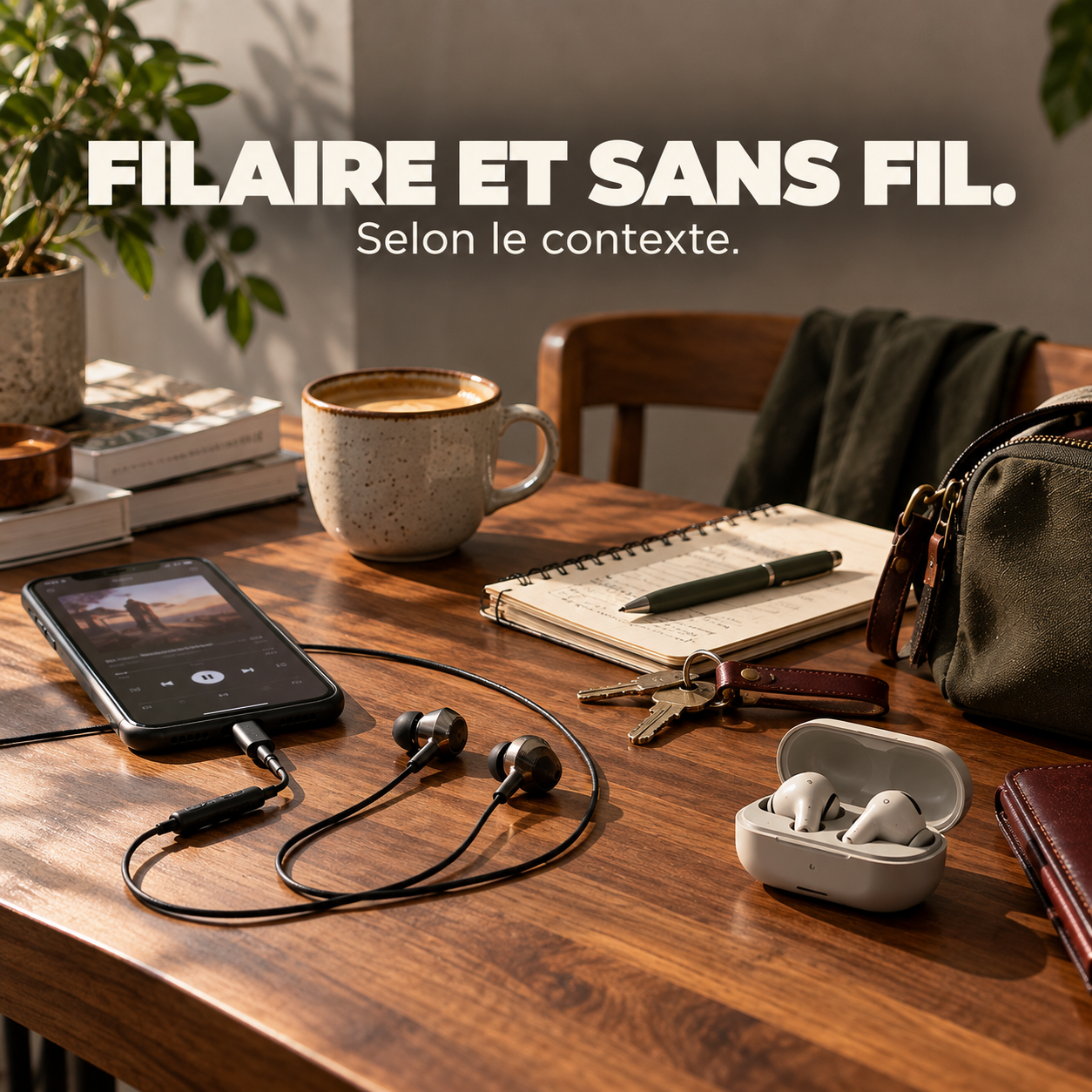
wired AND wireless, depending on the context.
So, wired headphones or wireless headphones?

This is where Global Zone prefers to let you decide.
There is no universal winner.
If you care most about freedom, sport, travel, calls and noise cancellation, the headphones without a cable may fit your needs better.
If you care most about simplicity, no battery, minimal latency, some ways of listening to music, or value for money, the headphones with a cable deserve your full attention.
And if you use your headphones in very different situations, you do not even have to choose.
You can have:
The return of wired headphones on some celebrities ultimately reminds us of something important:
a technology does not necessarily disappear when a new one arrives.
It can simply change roles.
Yesterday, the cable was a constraint.
Today, it can be a choice.
And tomorrow, it will still be up to you to decide what suits you best.
Avis des lecteurs
Votre avis compte
Partagez votre expérience et aidez d’autres lecteurs à mieux comprendre ce sujet.
Soyez le premier à donner votre avis.

